

If you’ve ever run a semi trash pump on a hot jobsite and suddenly noticed that metallic smell, weak flow, or even steam coming off the casing, you know the feeling. Overheating isn’t just annoying — it kills pumps. I’ve seen impellers seize up, mechanical seals turn into charcoal, and engine blocks crack because someone ignored the warning signs.
A semi trash pump is supposed to handle dirty water with small solids, but it’s not invincible. Most overheating problems come down to a handful of repeatable mistakes or conditions. Below are seven real causes I’ve run into in the field, followed by specific ways to prevent them.
1. Dry Running Without Water
This is the number one killer. A semi trash pump relies on the water it pumps to cool the mechanical seal and lubricate internal moving parts. Run it dry for even 30 seconds, and you’ll hear the seal start squealing. After a minute, temperatures inside the seal chamber can exceed 200°F (93°C). The rubber bellows hardens, the carbon face cracks, and the stationary seat warps.
I once watched a new operator start a Honda WX15 on a dry suction hose “just to test it.” Less than two minutes later, water was leaking through the seal weep hole. The repair cost almost as much as a new pump. If your pump loses prime or runs dry for any reason — suction line out of water, clogged strainer, or air leak — shut it down immediately.
2. Blocked Suction or Discharge Line
A partial blockage is more dangerous than a full one because the pump still moves some water, but the restricted flow creates intense heat. Think of it like pinching a garden hose but on the intake side — the pump fights against high vacuum while moving very little liquid. All that engine or motor energy turns into heat inside the volute.
Common culprits: a plastic bag over the strainer, a small stone wedged in the discharge elbow, or mud drying inside the hose after previous use. One sign of a blocked line is the pump running but delivering a weak, sputtering stream while the casing feels unusually hot to the touch (above 160°F / 70°C). Clear the line before restarting.
3. Pumping Excessive Sand and Slurry
“Semi trash” means it can pass small solids — typically up to ¾ inch (19 mm) for small models, maybe 1–2 inches for larger ones. But sand and silt are different. They don’t just pass through; they create a dense mixture that dramatically increases hydraulic resistance. The impeller has to churn through what’s closer to wet concrete than water.
Every pump has a maximum recommended solids concentration, usually below 10–15% by volume. When you push 30–40% sand, the impeller wears down in days, but more immediately, the friction generates heat that water circulation can’t remove. I’ve seen a 2-inch semi trash pump overheat in under 20 minutes when used to dewater a sand mining pit. The solution isn’t to “tough it out” — it’s to switch to a slurry pump or reduce the sand load.
4. Operating Beyond the Recommended Head
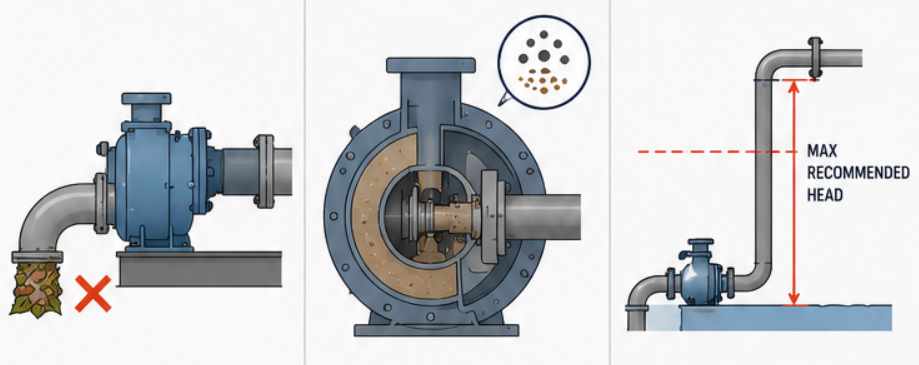
Head is the total resistance the pump works against — lift (vertical distance), friction loss in hoses, and discharge pressure. Every pump has a sweet spot on its performance curve. Run it too far to the right (low head / high flow) or too far left (high head / low flow), and overheating follows.
Low head (short hose, no elevation) lets the pump move maximum flow. That overloads gas engines — they bog down, RPM drops, and cooling fan speed slows. The engine overheats, then conducts heat into the pump housing. On the flip side, high head (pumping up a steep hill or through 200 feet of small-diameter hose) reduces flow so much that there’s not enough water moving through the pump to carry heat away. The water inside recirculates and gets hotter with each revolution. Check your pump’s rated head range. If discharge pressure feels unusually high or the engine sounds labored, you’re outside it.
5. Mechanical Seal Failure
The mechanical seal sits between the pump housing and the engine or motor shaft. Its job: keep water inside and air out. But seals are delicate. Sand, dry running, or simple age will wear down the seal faces. Once a seal fails, you get one of two overheating scenarios. First, a small external leak drips out — you lose cooling water, and eventually the pump runs low on prime. Second, air gets sucked in through the seal, the pump loses prime entirely, and you’re dry running again without realizing it.
A good habit: before each startup, check the seal weep hole (a small notch or hole between pump and engine). A few drops during initial priming is normal. A steady drip or any flow while running means the seal is failing. Replace it before it cooks the rest of the pump.
6. Poor Engine Ventilation and Cooling
On gas or diesel-powered semi trash pumps, the engine and pump are bolted together. A hot engine transfers heat directly to the pump casing through the mounting flange and shaft. If the engine runs hot because of clogged cooling fins, a dirty air filter, or operating in a small confined space like a pump pit or inside a shed, that heat migrates into the pump.
I once found a contractor running a 3-inch pump inside a concrete vault with barely six inches of clearance on three sides. The engine fan was just recirculating hot air. The pump casing was so hot it left blisters on a glove. Simply moving the pump into open air dropped operating temperature by 40°F. Also check that grass, mud, or debris hasn’t packed into the engine’s cooling shroud — it happens constantly on jobsites.
7. Continuous Heavy-Duty Operation
Some jobs demand a pump run for hours nonstop — dewatering a trench, draining a pond, or flood control. But semi trash pumps are typically rated for intermittent or moderate continuous duty, not full-throttle heavy load for eight hours straight. Heat builds up faster than it can dissipate, especially on a hot summer day.
The pump might last four hours, then the thermal overload on an electric motor trips (or the engine starts misfiring from vapor lock). Even without a trip, internal clearances shrink as metal expands. The impeller starts rubbing the volute, which creates more heat — a vicious cycle. For continuous heavy use, oversize the pump by 20–30%, or schedule a 10–15 minute cooldown every two hours. Let it idle with no load so water circulates and pulls heat out.
Final Thoughts
Semi trash pumps overheat for very real, preventable reasons. In my experience, 80% of overheating calls trace back to dry running, clogged lines, or pushing sand beyond the pump’s design. The other 20% come from worn seals, poor ventilation, or ignoring the pump’s head rating. None of these require a degree in engineering to fix. Pay attention to temperature, listen for changes in sound, and follow the prevention steps above. A pump that runs cool runs for years. One that overheats regularly will leave you with a seized impeller and a repair bill that could have bought a new pump.


Leave feedback about this