

In household cleaning and outdoor maintenance, gas pressure washer, with their powerful pressure and mobility, have become the preferred tools for many people. However, when using a spray gun alone to clean large areas of flat surfaces (such as driveways, courtyards, and patios), it is often time-consuming and labor-intensive, and it is prone to leaving streaks. At this point, the surface cleaner attachment can play a crucial role. It can significantly improve the cleaning efficiency and enable beginners to achieve professional-level cleaning results with ease.
However, for first-time buyers, the surface cleaners available on the market vary greatly in size, pressure range, interfaces, and materials. Choosing the wrong model not only results in unsatisfactory cleaning effects but may also affect the performance of the equipment. This article will help beginners understand how to choose the Surface Cleaner that suits them and introduce the most important points to consider when purchasing.
What is a Surface Cleaner? Why Should Beginners Use a Surface Cleaner?
The surface cleaner is essentially a circular or square housing device with a rotating nozzle. High-pressure water enters the accessory through a quick connector, driving the internal nozzle to rotate at high speed. At the same time, the housing restricts the water flow within a certain range to prevent it from splashing everywhere.
Ordinary spray guns clean the ground with a single water column and need to repeatedly move back and forth, which is prone to leaving obvious cleaning marks. However, the Surface Cleaner is usually equipped with two high-speed rotating nozzles inside, forming a uniform circular cleaning area protected by the housing, thus being able to cover a larger area at once.
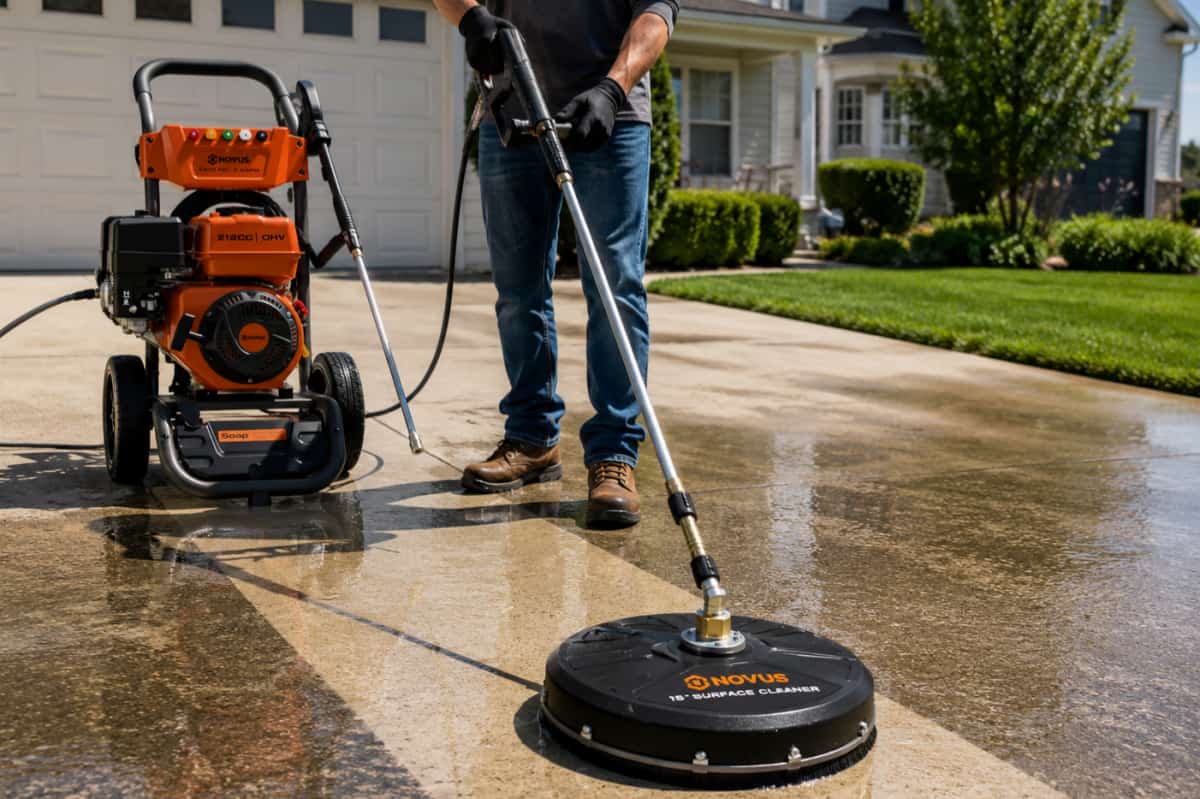
For beginners, it has the following main advantages:
- The cleaning speed is usually 2 to 4 times faster than that of ordinary spray guns.
- It is less likely to leave streaks or uneven cleaning marks.
- There is less water splashing, keeping the clothes and the surrounding environment clean.
- The operation is more effortless, and it won’t cause fatigue even after long use.
It is easier to master and doesn’t require complex cleaning techniques.
Whether it is a concrete driveway, garden, terrace or sidewalk, the Surface Cleaner can provide a more stable cleaning effect.
Important Considerations for Beginners When Choosing a Surface Cleaner
For beginners, it’s not necessary to pursue the largest model; instead, focus on whether the equipment is compatible.
Choose the appropriate size
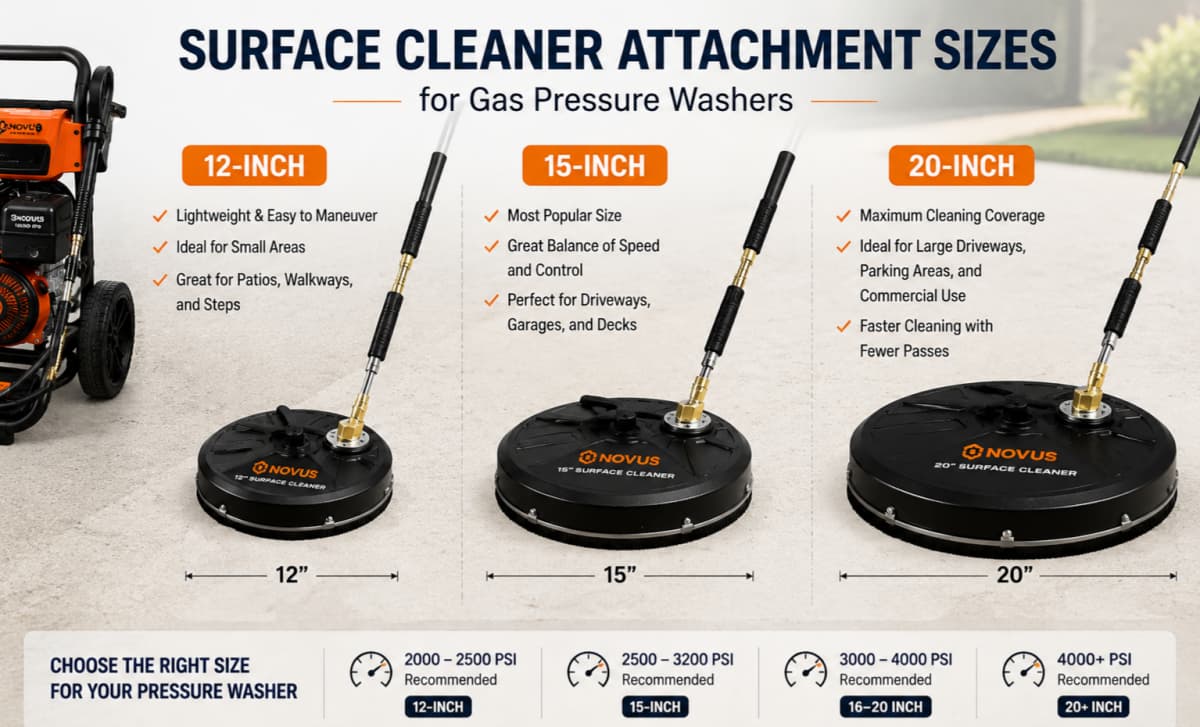
The common sizes of Surface Cleaner include 12 inches, 15 inches, 16 inches and above 20 inches.
- 12 inches: Suitable for machines with 2000–2500 PSI
- 15 inches: Suitable for 2500–3200 PSI, it is the best choice for most household users
- 16–18 inches: Suitable for 3000–4000 PSI
- 20 inches and above: More suitable for commercial cleaning or large venues
For beginners using pressure washer, 15 inches usually offers the best balance of cleaning efficiency, weight and maneuverability.
Pay attention to the match of pressure (PSI)
Many users believe that the higher the pressure, the better. However, what is more important is the maximum working pressure allowed by the attachment.
Before purchasing, it is necessary to confirm:
- Surface Cleaner’s maximum operating PSI
- High-pressure washer output pressure
If the machine’s pressure exceeds the rated value of the attachment, it may shorten the product’s lifespan and even damage the internal rotating components.
Don’t overlook the GPM
Apart from PSI, GPM (flow rate per minute) is equally important. If the flow is insufficient, even if the pressure is high, the rotating nozzle cannot maintain a stable speed, and problems such as uneven cleaning effect and residual stains are prone to occur. Therefore, it is advisable to choose a Surface Cleaner that matches the machine’s flow rate as closely as possible.
Check the interface type
Most household high-pressure cleaners currently use:
- 1/4 inch Quick Connect
- M22 threaded interface
Before purchasing, make sure to confirm the connection method of the high-pressure gun or spray pole to avoid purchasing additional conversion adapters.
Material affects durability
It is recommended to choose stainless steel or high-strength aluminum alloy enclosures, along with wear-resistant bearings. This will ensure stability during frequent use and extend the service life.
Best Surface Cleaner Type for Beginners
Budget type
Users with limited budgets can choose the basic model ranging from 12 to 15 inches. They are relatively inexpensive, lightweight, and perfect for occasional cleaning of patios, sidewalks, and small driveways.
Family general-purpose type (Best recommendation)
For the majority of household users, the 15-inch Surface Cleaner is the most recommended choice. It is usually compatible with 2800–3400 PSI gasoline pressure washer and can offer:
- Cleaning efficiency
- Operational convenience
- Coverage area
- Comfort of use
If you have only one pressure washer and want to clean various hard floors in your home, then this specification is usually the best choice.
Heavy-duty cleaning type
The 16 to 20-inch Surface Cleaner is more suitable for:
- Ultra-long driveways
- Commercial sites
- Large areas of concrete flooring
Although it has a larger coverage area, its weight has significantly increased, making it more difficult to control for beginners who are new to using it.
Is Surface Cleaner Suitable for Your Pressure Washer?
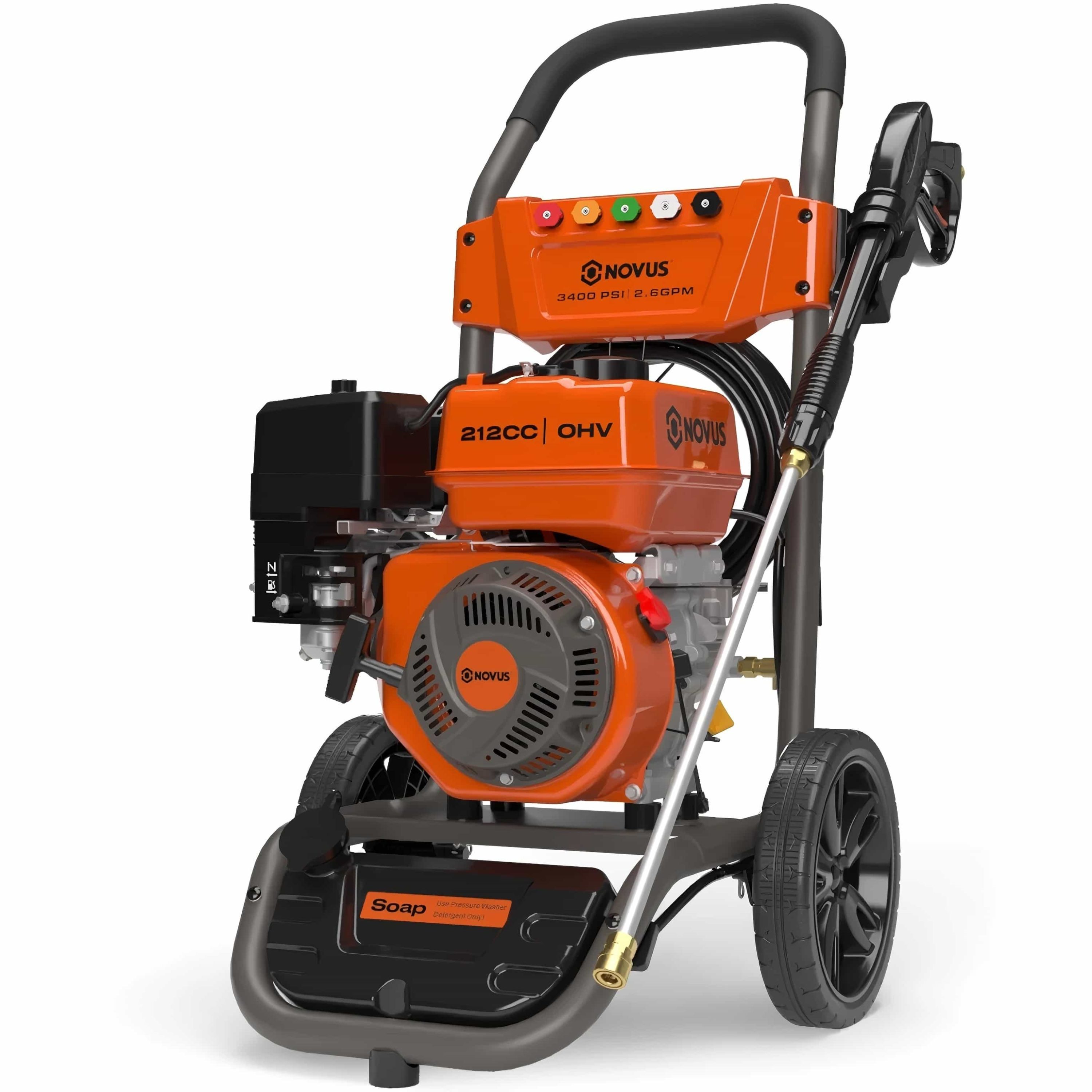
Generally speaking, choosing a Surface Cleaner that matches the performance of your pressure washer can fully utilize the capabilities of both. For most household users, a gasoline-powered pressure washer with 2800–3200 PSI and 2.3–2.8 GPM, paired with a 15-inch Surface Cleaner, offers the best balance of cleaning efficiency and control.
If you are choosing a pressure washer, it is recommended to prioritize models that can support common Surface Cleaner attachments. Novus’s Gas Pressure Washers feature standard quick-connect interfaces and provide stable pressure and flow output, which are compatible with most 12–15-inch Surface Cleaners and are perfect for cleaning outdoor areas such as driveways, patios, sidewalks, and garage floors in the home.
However, before using, be sure to confirm the maximum working pressure marked on the Surface Cleaner. Do not allow the output of the pressure washer to exceed the pressure range allowed by the attachment. Otherwise, it may accelerate the wear of the internal bearings, rotating arms, and seals of the spray disc.
For household users, unless you need to clean extremely large driveways or commercial areas for a long time, there is no need to blindly pursue a larger Surface Cleaner. Choosing a size that matches the pressure washer is usually more important than simply choosing the largest model.
Common Mistakes for Beginners
Many users find Surface Cleaner very easy to use, but the following mistakes are quite common:
- Choosing an attachment that is too large, resulting in insufficient machine power.
- Focusing only on PSI and ignoring the matching of GPM.
- Pushing too fast, making the stains unable to be completely removed.
- Staying in the same position for a long time, which is prone to leaving color differences.
- Using on gravel roads or loose ground, causing stones to fly.
- Not cleaning leaves and debris before use, resulting in the nozzle getting clogged.
- Not rinsing the attachment after use, causing long-term accumulation that affects the rotation effect.
Avoiding these problems can not only improve cleaning efficiency but also extend the service life of the attachment.
Conclusion
For beginners who use gas-powered pressure washer, a suitable surface cleaner attachment can significantly enhance the cleaning experience, making the previously arduous outdoor cleaning tasks much easier and more efficient. As long as you select the products that match the high-pressure washer and master the correct usage and maintenance methods, even beginners can easily complete the cleaning of various outdoor hard surfaces such as driveways, patios, and sidewalks.


Leave feedback about this