

Imagine three real scenarios:
- One night after a heavy rain, there was a sudden power outage. The refrigerator was filled with freshly bought fresh produce and the phone’s battery was running low
- At a campsite far from the power grid, you want to cook a hot meal or take a photo, but there is no stable power supply
- At a small construction site in operation, the progress is forced to be interrupted as soon as the electric drill stops
Behind these scenarios, in fact, all point to the same demand:
→A stable, controllable power source that won’t “fail at critical moments”
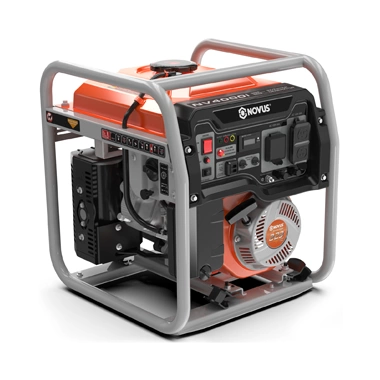
It is precisely for this reason that the 4000-watt inverter generator has become one of the most popular power segments in homes, camping, recreational vehicles and light operations.
But the problem is:
- Can 4000 watts really “power everything”?
- Are air conditioners and induction cookers really okay?
- Why do some people work smoothly while others frequently overload?
This article will help you thoroughly understand its true capabilities, allowing you to use it with confidence, safety and efficiency.
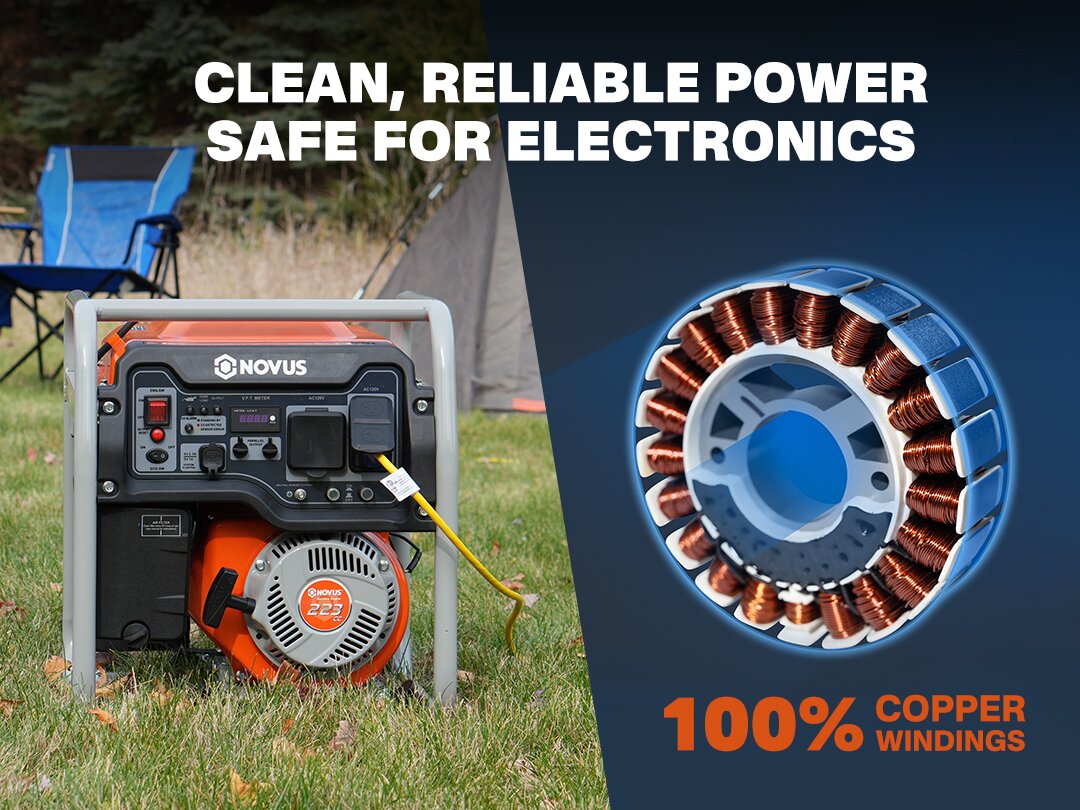
Understanding Power Core: Difference Between Rated Power And Peak Power
Rated power vs. Peak Power: Who is the Key?
Many people only focus on the figure of “4,000 watts”, but overlook the meaning behind it.
It can be understood in this way
- Rated power (e.g. 3500W)
The power that a generator can stably output for a long time is equivalent to human “endurance”. - Peak power (4000W)
The maximum power that a generator can generate in an extremely short period of time is equivalent to “sprinting power”.
Practical suggestions
For stability, fuel efficiency and extended service life, the long-term load should not exceed 80% of the rated power.
If the rated power is approximately 3600W, it is recommended to keep it within about 2900W.
Electrical Appliance Startup Shock: The Hidden “Power Killer”
This is the reason that beginners are most likely to overlook and also the one that most easily leads to engine stalling or alarm.
Why do some electrical appliances fail to hold up as soon as they are turned on?
Reason: All electrical appliances with motors experience a surge in power during startup.
Common magnification references
Refrigerator/water pump: ≈ 3 times
Air conditioning/power tools: ≈ 4-5 times
Important judgment logic to remember:
- At startup, check if the peak power is sufficient.
- After startup and continuous operation, check if the rated power can handle it.
This is why: Refrigerators can run continuously, but air conditioners are prone to startup failures.
What Will a 4000 Watt Inverter Generator Run?
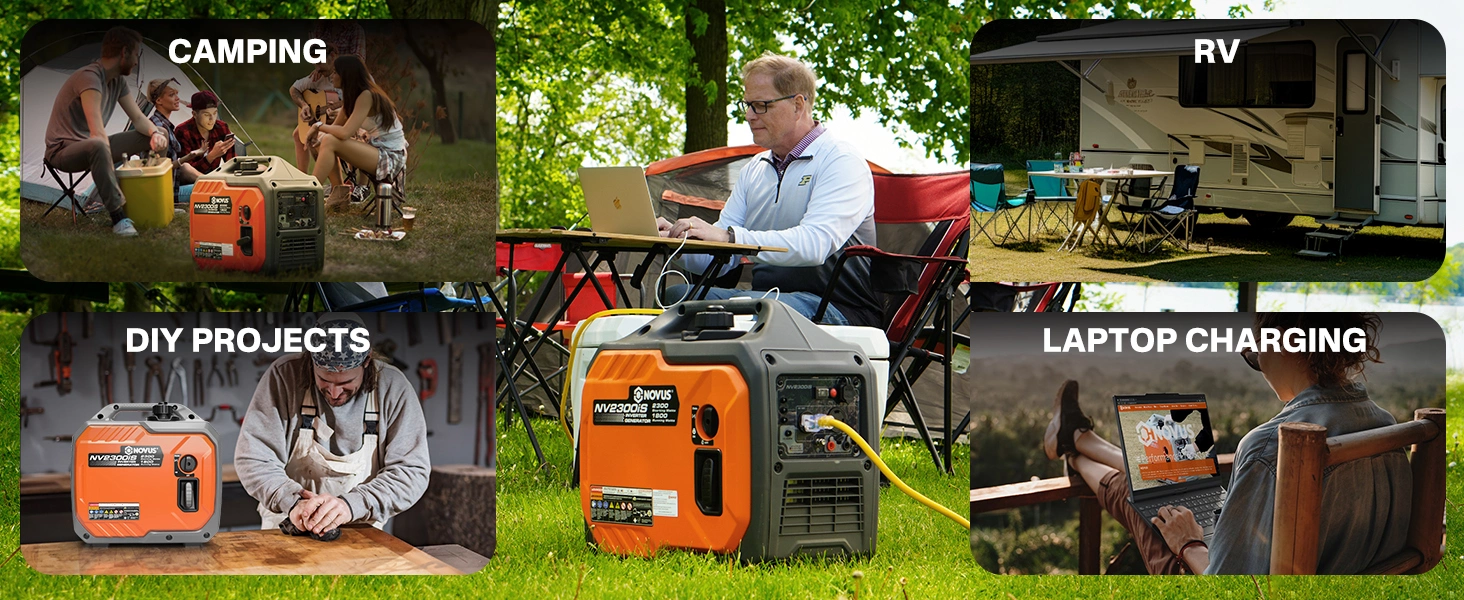
A combination of low-power appliances that are easy to handle
These electrical appliances are very friendly to generators and belong to low-power or resistive loads.
Common power range
- LED lamp (single) : 10-20W
- Router: 15-25W
- Laptop: 50-100W
- Television: 100-2 million watts
- Rice cooker (warm/low setting) : 300-800W
Principle of use
As long as the total power used simultaneously is ≤ 2900W, it can be flexibly combined and operate stably.
High-power appliances (air conditioners, induction cookers, etc.) require caution.
The following electrical appliances are not unusable, but the startup issue must be considered separately:
- 1-1.5 horsepower air conditioners (the core difficulty lies in starting)
- Induction cooker (high power setting)
- Electric kettle
- Electric heater
The correct usage can be summarized in one sentence: When using them, try not to stack them with other high-power electrical appliances
For example:
- When starting the air conditioner, turn off the induction cooker first
- When the electric kettle is boiling water, suspend other non-essential loads
A high-power device that is absolutely impossible to drive
The following devices are not recommended for trial
Instant electric water heater
Large electric oven
Central air conditioning
Industrial-grade welding machines, large compressors
The reason is very simple:
Both the continuous power and the starting power far exceed the design boundary of 4000W.
Practical Application Scenarios: Home, Camping And Construction Site Solutions
Family emergency backup plan: Full coverage of refrigerator, lighting and communication
Objective: To maintain a basic living standard and not pursue “full house electrification”.
Example combination
- Refrigerator: 200W
- LED light ×3:60W
- Router: 20W
- Mobile phone charging: 30W
about 3100,000 in total
✔ Extremely low load, quiet, fuel-efficient, and capable of long-term operation
Time-of-use electricity usage tips
When boiling water or cooking, temporarily turn off some lighting or entertainment equipment.
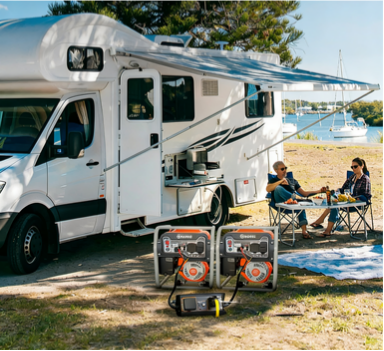
Camping and RV Power Solution: Cooking, Refrigeration, and Entertainment All in One
Goal: To make outdoor living “as comfortable as home.”
Example Combination:
Mini Induction Cooker: 1200W
Vehicle Refrigerator: 80W
Projector: 150W
Total: Approximately 1430W
✔ Still operating at high efficiency, with ample headroom.
Small-scale construction site/work plan: Power tool safe operation techniques
Objective: Ensure stable tool operation and prevent work stoppage due to overload.
Key operating points:
Stagger the start of electric drills and angle grinders.
Do not start multiple motorized tools simultaneously.
Use a “rotational operation” strategy when necessary.
Safety and Efficiency: Correct Use of Inverter Generators
Choose “Pure Sine Wave” to Protect Delicate Appliances
Inverter generators come in “pure sine wave” and “modified sine wave” (or square wave) versions. For modern living, always choose the pure sine wave.
Its output current waveform is almost identical to mains power, as safe as “pure water,” providing perfect protection for your laptops, smartphones, flat-screen TVs, medical equipment, drone batteries, etc. Modified waves may damage equipment or cause excessive noise and low efficiency.
Correct Connection and Start-up/Shut-down Sequence
- Start-up: Start the generator under no-load conditions and wait for it to stabilize.
- Connection: First, turn on the switch of the single highest-power appliance (especially motors) to allow it to start smoothly. Then, turn on appliances with smaller loads one by one.
- Shut-down: The sequence is reversed. First, turn off all appliance switches one by one, allowing the generator to run under no-load for 1-2 minutes, then turn off the generator.
Fuel Efficiency, Ventilation, and Maintenance
- Always use outdoors in a well-ventilated area.
- Keep away from doors, windows, tents, and vehicles.
- The most fuel-efficient and longest-lasting range: 50%–80% of rated power
Final summary
The 4000-watt inverter generator is the “golden balance point” for home emergencies, camping RVS and light operations.
A 4000-watt (peak) inverter generator is an excellent companion. It can easily cover the basic needs of a family during a blackout, illuminate the cozy nights in a remote campground, and be a dependable power source for DIY projects of small scale.
Electricity is the modern human existence’s driving force. My intention is that this text not only leads you to a power source but also to the states of mind of composure, safety, and the ability of going off the beaten track.


Leave feedback about this