

In modern life, from the comfort of outdoor camping to the emergency of sudden power outages at home, a reliable and quiet generator is of vital importance. Inverter generators, with their outstanding power quality and fuel efficiency, are becoming the first choice for an increasing number of people. But are you curious about how it manages to be both lightweight and quiet, while still providing your laptop and smartphone with a stable power supply like that of a mains? This article will explain the working principle of inverter generators in a simple and clear way and explore why they are so excellent.
What is An Inverter Generator?
An inverter generator is a power generation device that uses advanced electronic inverter technology to provide stable alternating current (AC). Unlike traditional generators that directly output the original current, its core lies in the “inversion” process – that is, the current is “purified” and precisely controlled through a series of electronic components.
A simple comparison: Traditional generator engines operate at a constant high speed (such as 3000 revolutions per minute), directly generating alternating current with frequency and voltage fluctuations. The engine speed of the inverter generator can be intelligently adjusted according to the load. The generated current undergoes multiple processes, and the final output is “clean electricity” with a smooth waveform and extremely stable voltage and frequency.
The Working Principle of An Inverter Generator: Four-Step Conversion
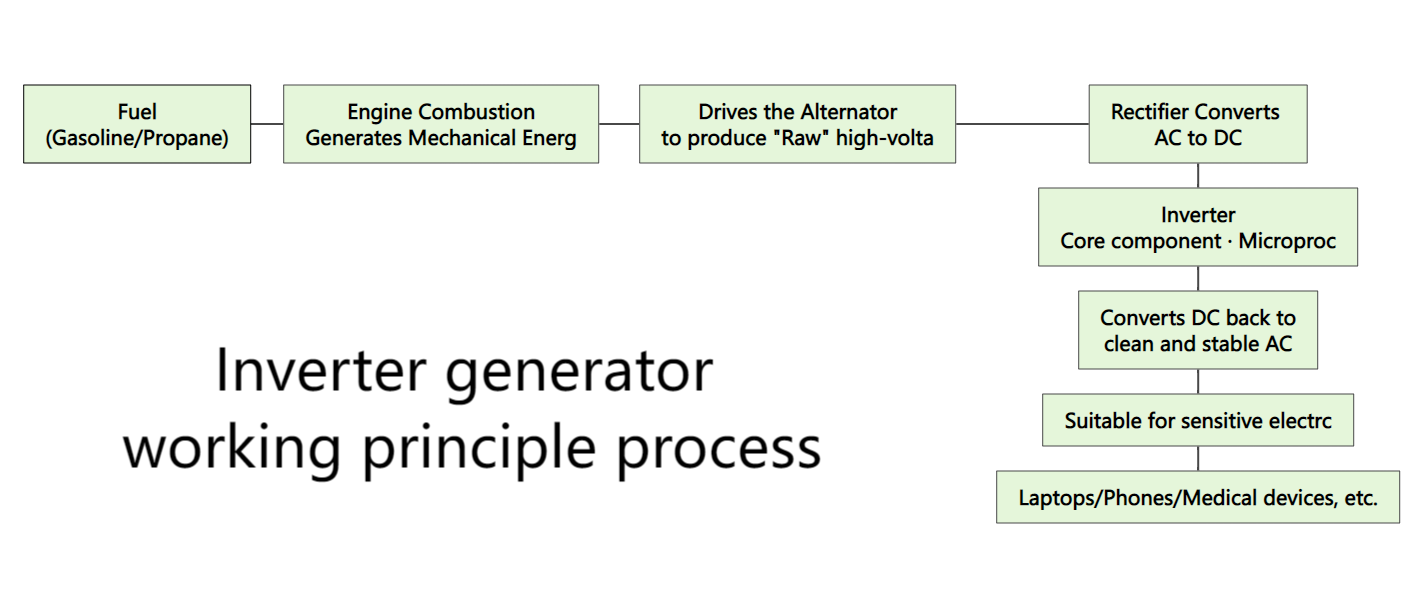
The core working process of an inverter generator can be summarized into four key steps, which is a purification process from “crude electricity” to “refined electricity”.
Step 1: Generate electricity from the engine
Similar to traditional generators, the entire process begins with an internal combustion engine (typically using gasoline or propane). The engine burns fuel to generate mechanical energy, which drives the Alternator connected to it, thereby generating the initial unstable alternating current. However, the alternating current generated at this time has unstable voltage and frequency and cannot directly supply power to precision equipment.
Step 2: Rectifier conversion – from AC to DC
This is the first key point of inverter technology. The raw alternating current generated by the generator is first sent to a component called a Rectifier. The function of a rectifier is like a check valve, converting alternating current (AC) with alternating directions into direct current (DC) with a single direction. This step is a very crucial “transitional link” in the entire inverter system.
Step 3: Inverter conversion – from DC to pure AC
This is the “brain” and core technology of the entire system. The direct current obtained in the previous step is sent to the Inverter. Inverter consists of microprocessor and precise switching circuits (like IGBTs) that internally control the inverter and work by “cutting” the direct current at very high speeds and transforming it into an extremely smooth alternating current. The microprocessor constantly checks the output to guarantee that the voltage and frequency are kept at exact values (for instance, 220V/50Hz or 110V/60Hz) and that the waveform is a perfect sine wave, giving power quality that is no different from or even better than that of a domestic wall socket.
Step 4: Output stable power
The current that has been “purified” by the inverter is ultimately supplied to the electrical equipment through the output interface on the generator. The level of this particular type of power harmonic distortion is very low and absolutely safe. Such a power supply can be provided directly to the most sensitive electronic devices, like computers, tablets, audio equipment, medical devices and so on, without the risk of damage being a concern.
Brief summary of the process
Engine → Raw alternating current → Rectified into direct current → inverted into high-quality alternating current → Stably output to equipment for use
This is precisely where the name “inverter generator” comes from.
Inverter generator vs. Traditional Generator: Essential Difference in Working principle
| Comparison project | Inverter generator | Traditional generator |
| Output method | Inverter control output | Direct mechanical output |
| Voltage stability | Very stable | It fluctuates greatly. |
| Output waveform | Pure sine wave | Square wave or distorted wave |
| Engine speed | Intelligent regulation | The base constant high speed |
| For precision equipment | Very safe | There is a risk of damage. |
| Noise | low | high |
| Fuel consumption | low | high |
The conclusion is very clear:
If you need to power electronic devices, an inverter generator is a safer and more advanced choice.
What are the core advantages of inverter generators?
1. The output power is more stable, protecting precision equipment
The output of the inverter generator is “pure electricity” close to the quality of the municipal power supply, and there will be no:
The voltage fluctuates
Electric current impact damages equipment
Problems such as equipment freezing and motherboard burning
This is particularly important for computers, servers and medical equipment.
2. The noise is significantly lower, making it more suitable for camping and home use
Since the inverter generator can automatically adjust the engine speed according to the load:
At low load: low speed, low noise
Under high load: Intelligently increase the rotational speed
Compared with the “constant high speed” mode of traditional generators, inverter generators are quieter and more comfortable.
3. More fuel-efficient and lower operating costs
The inverter generator is equipped with an intelligent load identification system:
Less electricity consumption → Automatic speed reduction → Less fuel consumption
High power consumption → Automatic speed increase → Ensure power supply
In contrast, ordinary generators are almost always running at full speed, so their fuel consumption is naturally higher.
4. It is small in size, light in weight and more portable
Inverter generators are widely adopted
Lightweight materials
Integrated electronic control system
Therefore, it has a significant advantage in camping, RVS, and outdoor operations.
Main Application Scenarios
- outdoor camping, self-driving Tours, rv power supply
- household power outage emergency backup power supply
- power supply for computers, printers and office equipment
- maintenance, photography, e-commerce live streaming
- yachts, power tools, outdoor commercial electricity
As long as you need to generate electricity and have requirements for “power quality”, inverter generators are very suitable.

The Shortcomings and Limitations of Inverter Generators
The initial cost is relatively high: The technical complexity and the use of electronic components make its price usually higher than that of traditional generators of the same power.
There are fewer high-power options: Although the power range is constantly expanding, the choices of single-unit ultra-high power (such as over 10 kilowatts) inverter generators are still not as many as those of traditional generators, and they are also expensive.
Key parameters that must be paid attention to when purchasing an inverter generator
When making an actual purchase, it is recommended to pay close attention to the following parameters:
- Rated power & Peak power
- Whether the output waveform is a pure sine wave
- Noise value (dB)
- Fuel tank capacity & battery life
- Whether parallel expansion is supported
- Whether it has overload, short circuit and high-temperature protection
- Does it support USB and fast charging interfaces
These parameters directly determine your experience, safety and application scope when using it.
Conclusion
In summary, the working principle of an inverter generator is an intelligent conversion process of “AC-DC-AC”, and its core lies in the use of inverters and microprocessors to reshape and precisely control the current. Although its purchase cost is higher, the clean electricity, fuel economy, low noise and excellent equipment compatibility it brings make it an ideal choice for powering modern electronic devices. Whether you are pursuing a quality outdoor life or ensuring the emergency needs of your family, understanding how it works can help you make wiser purchasing decisions.
Frequently Asked Questions (FAQ)
Q1: Can inverter generators directly charge laptops and mobile phones?
Absolutely fine. In fact, it is the best choice for powering such sensitive electronic devices. The stable sinusoidal power it outputs is of the same quality as the mains power, which can effectively prevent equipment damage.
Q2: Are inverter generators really more fuel-efficient than traditional generators?
Yes, this is one of its main advantages. Because its engine adopts variable frequency technology, it automatically runs at low speed when the load is small, which naturally significantly reduces fuel consumption and noise, and greatly extends the driving range.
Q3: Does an inverter generator require special maintenance?
Basic maintenance is similar to that of traditional generators: use stable fuel, change engine oil regularly, clean the air filter, drain the fuel when not in use for a long time, and store properly. Due to its more precise circuit, it should be avoided to be used in extremely humid or dusty environments.
Q4: Is the electricity output by all inverter generators equally “clean”?
The vast majority of inverter generators from regular brands output pure sine waves. When purchasing, please confirm the product specifications and choose the one clearly marked as “Pure sine wave”. This is the safest type for precision equipment.
Q5: Can I connect two inverter generators in parallel to achieve greater power?
Many models support parallel connection (parallel connection cables need to be purchased separately). By connecting two machines of the same model in parallel, the output power can be doubled, offering high flexibility. It is a smart solution for gradually increasing the demand for electricity.


Leave feedback about this