

When choosing a water pump, the most frequently asked question by everyone is: How far can this pump push water? Whether it is for pumping out floodwater in basements, irrigating farmland, clearing pond water, or providing temporary water supply at construction sites, it is necessary to determine the actual water conveyance distance in order to select a pump that matches the working conditions and avoid purchasing one that fails to meet the usage requirements.
However, the actual water conveyance distance cannot be given a fixed numerical value. The actual distance that a pump can convey water is constrained by many factors: the maximum lift of the pump itself, the thickness of the water pipe, the height difference, and the resistance caused by the pipeline all have an impact. This article will dissect various factors that affect the water transmission distance, analyze the root causes of deviations between theoretical parameters and actual conditions, and provide practical techniques to maximize the pumping efficiency of the water pump.
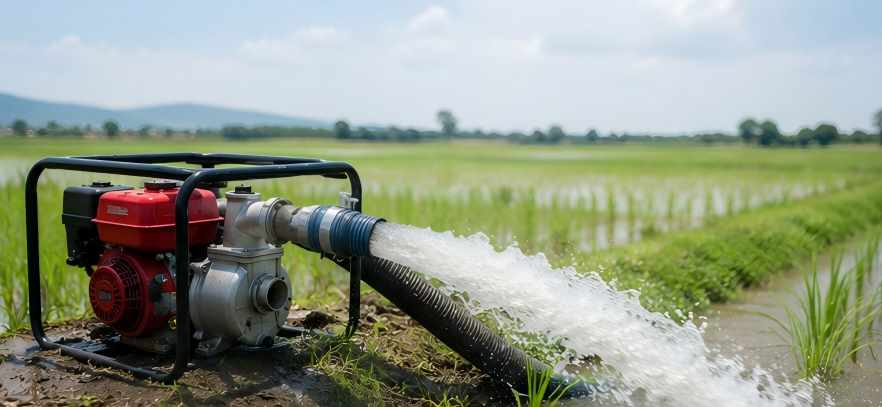
How Far Can a Water Pump Actually Push Water?
Theoretically, there is no hard limit on the horizontal water transportation distance of a pump. However, the length of the distance does not directly determine the pumping effect. As the water flows through the pipeline, it will lose pressure due to friction against the pipe walls and differences in elevation. The farther the distance, the more obvious the water pressure attenuation.
Therefore, manufacturers will not indicate a single “maximum transportation distance”. They will only provide rated head and flow parameters. These numerical values are only results of standard testing conditions and cannot be applied to all on-site scenarios.
Take agricultural irrigation as an example: using a gasoline engine pump to draw water from a pond, the water flow is abundant when using short pipes and flat ground; if the pipe is extended and pumping uphill, even if the pump is operating normally, the water output will significantly decrease.
The same applies to basement drainage and site water pumping. Even if the water can be transported over a long distance, the actual water output per minute will be much lower than the equipment’s rated flow.
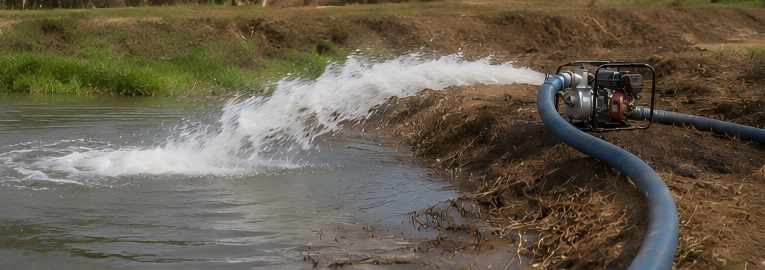
Rather than asking only “How far can a pump push water?”, it’s more helpful to ask:
- How much water needs to be moved?
- How high does the water need to be lifted?
- How long is the discharge hose?
- Will the pump maintain enough flow for the job?
Answering these questions provides a much more accurate expectation of real-world performance.
Why Doesn’t My Water Pump Reach Its Rated Distance?
If your pump isn’t performing as expected, it doesn’t necessarily mean something is wrong. Product specifications are typically measured under controlled conditions, while actual job sites introduce additional challenges.
Long or Undersized Hoses

The longer water travels through a hose, the greater the friction loss becomes. Similarly, using a hose that’s smaller than the pump’s outlet can create additional resistance and reduce both flow and pressure.
Selecting the correct hose diameter and keeping hose lengths as short as practical can help improve overall performance.
Elevation Changes
Pumping water uphill requires additional energy. Even moderate elevation gains can reduce flow compared with pumping across flat ground.
For applications involving hills, elevated storage tanks, or multi-level construction sites, it’s important to consider both horizontal distance and vertical lift rather than focusing on distance alone.
Pipe Bends and Fittings
Every elbow, connector, valve, or sharp bend increases resistance within the system. While a single fitting has little impact, multiple bends over a long pipeline can noticeably reduce pumping efficiency.
Keeping the discharge line as straight as possible helps minimize unnecessary losses.
Water Conditions
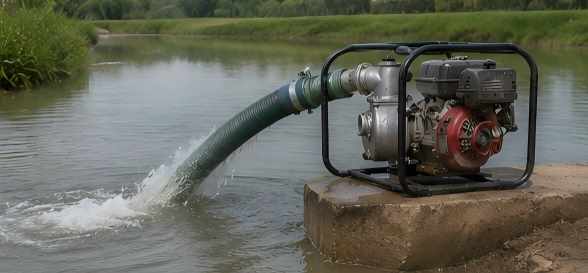
Not every application involves perfectly clean water.
For example, draining ponds, construction excavations, or floodwater often means handling water that contains sand, leaves, or other small debris. These materials increase resistance and may reduce pumping efficiency if the pump is not designed for such conditions.
A semi trash water pump is designed to handle water containing small suspended solids more effectively than a standard clean-water transfer pump, making it a practical choice for many outdoor drainage and construction applications.
Pump Maintenance
Routine maintenance also affects performance. Worn seals, clogged strainers, dirty air filters, or engine issues can reduce pumping efficiency over time.
Following the manufacturer’s maintenance recommendations helps ensure the pump continues operating close to its intended performance.
Simple Ways to Improve Your Water Pump’s Performance
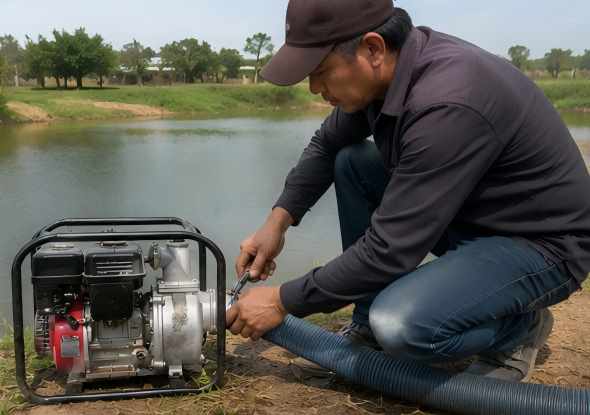
The pump itself has a performance limit, but by making a few simple adjustments, the pumping effect can be significantly improved:
- Match the pipe diameter: The diameter of the water pipe should be as consistent as possible with the pump’s inlet and outlet. A larger diameter will increase pipeline friction and reduce water output.
- Shorten the suction pipe: The suction end is more sensitive to losses. Place the pump as close to the water source as possible to reduce suction loss and facilitate water intake when starting.
- Reduce pipe bends: The pipeline should follow a straight path as much as possible, and avoid sharp bends to reduce water flow resistance.
- Standardize water intake operation: Most centrifugal pumps must be purged of air before starting. Air accumulation in the pipe will directly lead to weak pumping.
- Check pipe sealing: Even if there is no leakage, air leakage at the suction pipe interface will seriously weaken the pumping performance. Make sure to do a good job with sealing.
- Adhere to daily maintenance: Regularly clean the filter, replace the oil, and clean the air filter to ensure the pump can output steadily for a long time.
The performance improvement brought about by these operations often exceeds most people’s expectations.
Choosing a Water Pump That Matches Your Job
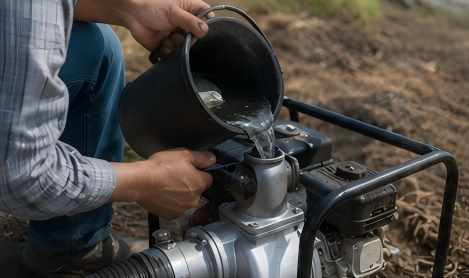
When choosing a pump, avoid blindly opting for high-power models. Instead, make a judgment based on your specific working conditions.
Before selecting the model, clarify the following four requirements:
- The amount of water to be pumped per unit time;
- The actual distance of water transportation and the height difference;
- Whether the water body contains impurities such as sand and fallen leaves;
- Whether the pump is for temporary use or for long-term continuous operation.
In summary, matching the working conditions is far more crucial than simply considering the distance of water transportation.


Leave feedback about this