

Many users when selecting a pressure washer usually pay most of their attention to the PSI rating, thinking that the better the pressure the more effective the cleaning. Nevertheless, in practice, it turns out that: for the same pressure washer, different models considerably vary in cleaning efficiency and user experience.
The reason lies in that – what truly determines the cleaning effect is the combination of PSI and GPM, rather than a single parameter.
In simple terms:
PSI determines whether the dirt can be removed, while GPM determines how quickly the cleaning process occurs.

What Is PSI and How Does It Affect Cleaning Power?
PSI (Pounds per Square Inch) refers to the pressure intensity of water flow when it strikes a unit area. In the process of high-pressure cleaning, PSI is mainly responsible for providing the impact force, which is used to break down and remove stubborn dirt.
The actual mechanism of PSI
When water is sprayed onto the surface at a high PSI, it creates an instantaneous impact on the dirt, causing the soil, oil stains or mold spots that are attached to the surface to loosen or even fall off directly. Therefore, PSI determines “whether the dirt can be removed”.
Typical PSI Ranges and Their Applications
- 1,300–1,800 PSI: Car washing, windows, outdoor furniture
- 2,000–2,800 PSI: Wooden floors, patios, fences, floor tiles
- 3,000 PSI and above: Concrete, driveways, industrial equipment, heavy oil stains
Why Higher PSI Is Not Always Better
An excessively high PSI may cause damage to the surface, such as:
- Wood fibers being lifted
- Paint or coatings peeling off
- Damage to brick joints and sealants
Therefore, the selection of a reasonable PSI is more important than the maximum pressure.
What Is GPM and Why Does It Determine Cleaning Speed?
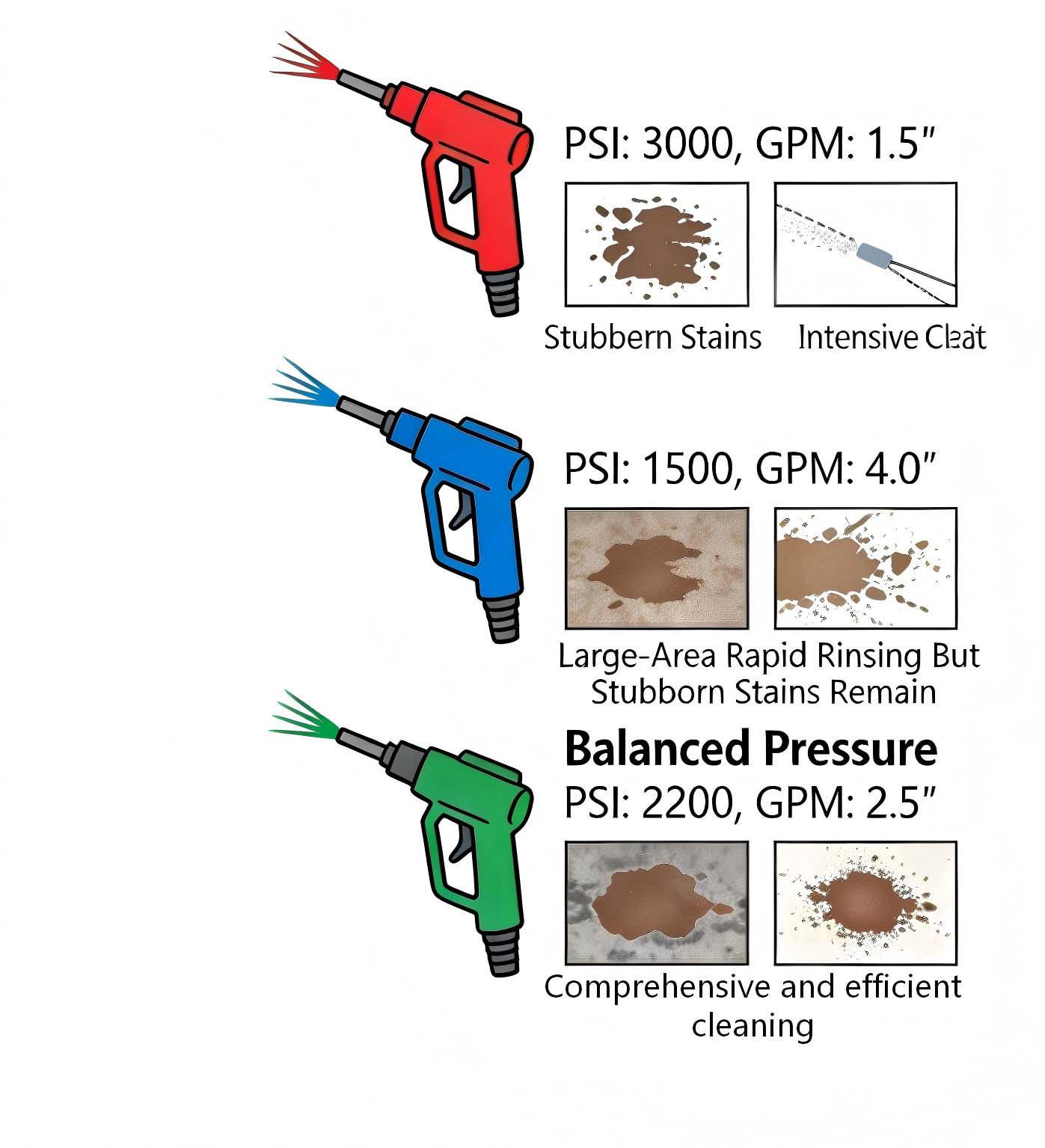
GPM (Gallons Per Minute) refers to the amount of water discharged by the pressure washer per minute. Unlike PSI, GPM determines the cleaning speed and efficiency.
The Real Role of GPM in Pressure Washing
After the dirt is disintegrated by high pressure, whether it can be quickly removed depends on whether there is sufficient water volume.
The higher the GPM (gallons per minute), the stronger the ability to wash away the dirt within a unit of time.
Low GPM vs High GPM: What You’ll Notice
- Low GPM: The dirt is broken up, but it tends to flow back and forth on the surface and requires repeated cleaning.
- High GPM: The dirt is quickly removed from the surface and can be cleaned in one pass.
Why Professional Pressure Washers Prioritize GPM
In large-scale or continuous operations, the cleaning efficiency is more important than the single-point impact force.
This is why commercial and industrial-grade pressure washers usually have higher GPM.
True Cleaning Power Comes from Combining PSI and GPM
In the industry, Cleaning Units (CU) are commonly used to measure the overall capacity of a high-pressure washer. The calculation method is: CU = PSI × GPM
Real-World Comparison
| PSI | GPM | CU |
| 3000 | 2.0 | 6000 |
| 2500 | 3.0 | 7500 |
This comparison demonstrates:
Whenever the right PSI is reached, the increasing of GPM will most likely lead to a good increase in overall cleaning efficiency.
The Best Strategy: Balance, Not Extremes
Rather than pursuing an extremely high PSI, it is better to opt for a configuration with a medium-high PSI and a higher GPM, which is both safe and efficient.
Recommended PSI and GPM for Common Cleaning Tasks
Car washing and fine surface cleaning
PSI: 1200–1800
GPM: 1.5–2.0
Excessive pressure can damage the paint surface, while a high GPM rate can reduce the need for repeated rinsing.

Wood floor and terrace cleaning
PSI: 1500–2500
GPM: 2.0–2.5
The key is to remove dirt without damaging the wood structure.
Concrete and lane cleaning
PSI: Above 3000
GPM: 2.5 – 4.0
Strong impact combined with large water volume significantly improves efficiency.
Industrial equipment and heavy oil contamination
GPM: 4.0 or above
In industrial settings, GPM is often the key parameter that determines the efficiency of operations.
Other Factors That Affect PSI and GPM Performance
Nozzle Type and Spray Angle
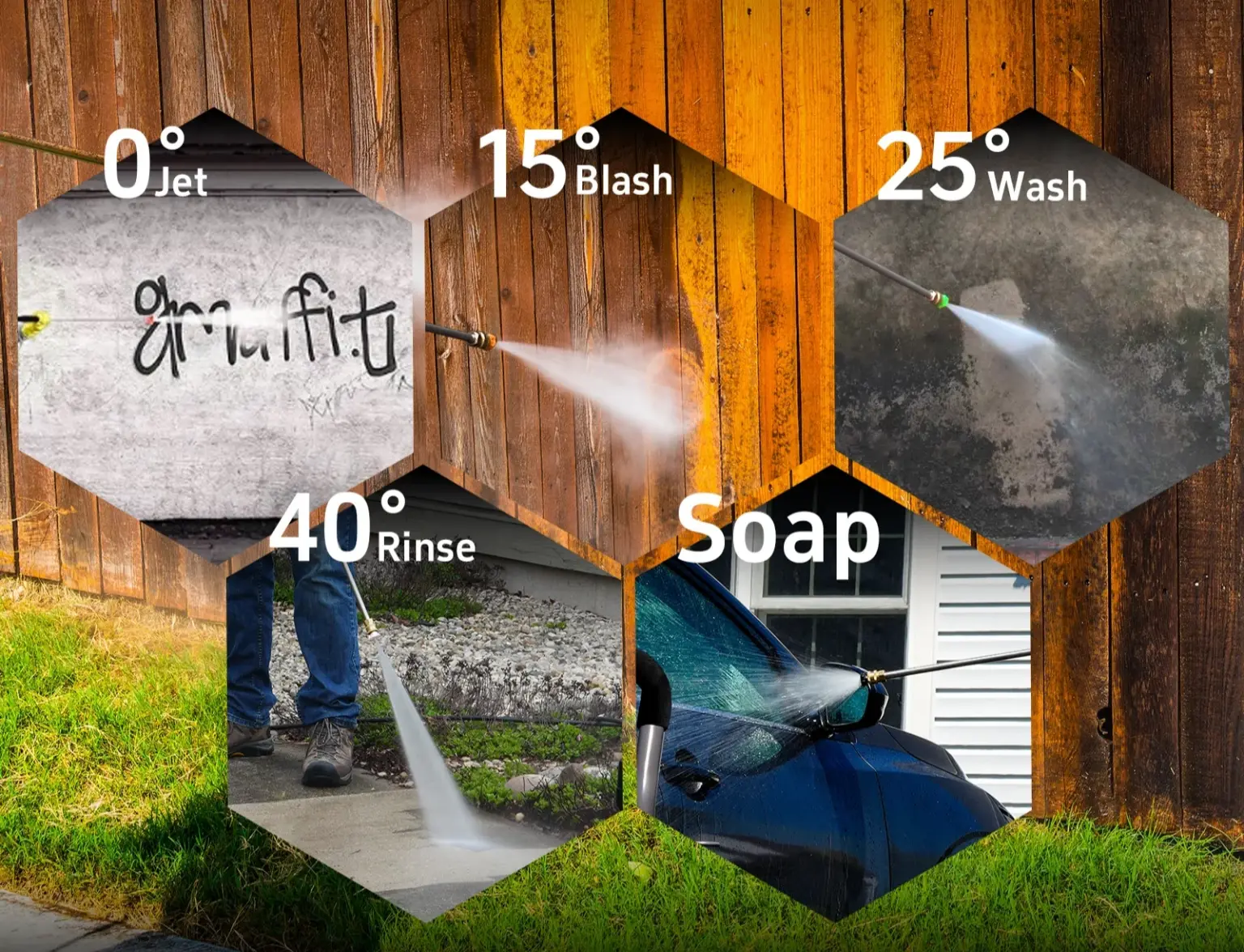
The nozzle angle directly affects the effective PSI and coverage area.
The smaller the angle, the more concentrated the impact force; the larger the angle, the wider the coverage range.
Water Supply and Inlet Conditions
Inadequate water pressure or a small inlet pipe diameter can lead to a situation where the actual GPM output of the equipment is limited, thus, it will also have an impact on the cleaning effect.
Common Mistakes That Reduce Cleaning Effectiveness
Focusing Only on PSI
High pressure with insufficient water flow leads to slow cleaning and frequent rework.
Using the Wrong Settings for the Surface
Excess PSI on delicate materials can cause irreversible damage without improving results.
Conclusion
PSI is a measure that decides if the dirt can be removed, whereas GPM is a measure that indicates the speed of the cleaning process. The best performance in pressure washing is achieved through the proper balancing of both, not through sheer pressure alone.
First, identify the areas and types of cleaning you need a pressure washer for before selecting one. The combination of the right PSI and GPM facilitates quicker and safer cleaning and overall better results.


Leave feedback about this