

For any gardener or self-sufficient farmer, the arrival of the planting season is always accompanied by excitement and a fundamental task: preparing the soil. A powerful tillage machine can turn heavy physical labor into a satisfactory job. But when you start looking for the right machine, you will soon face a crucial choice: rear tooth tiller or front tooth tiller?
This is not merely a minor detail; It is the key to distinguishing a machine that can handle hard soil with ease from one that struggles in it. Making the wrong choice means wasting money and endless troubles.This comprehensive guide will provide a detailed analysis of the differences, advantages and disadvantages of each type, helping you make the perfect choice for your land.

What is a Front Tine Tiller?
The working principle of the front tooth tiller: The power of the engine is mainly transmitted to the tires in front. The tires act as “driving wheels”, propelling the entire machine forward. The tines, located at the front of the machine, are driven components that rotate passively by being dragged along by the machine.
Advantages
- High cost performance
- The body is lightweight and convenient for transportation and storage
Disadvantage
- Weak power
- The operation is laborious.
- The depth of cultivation is limited.
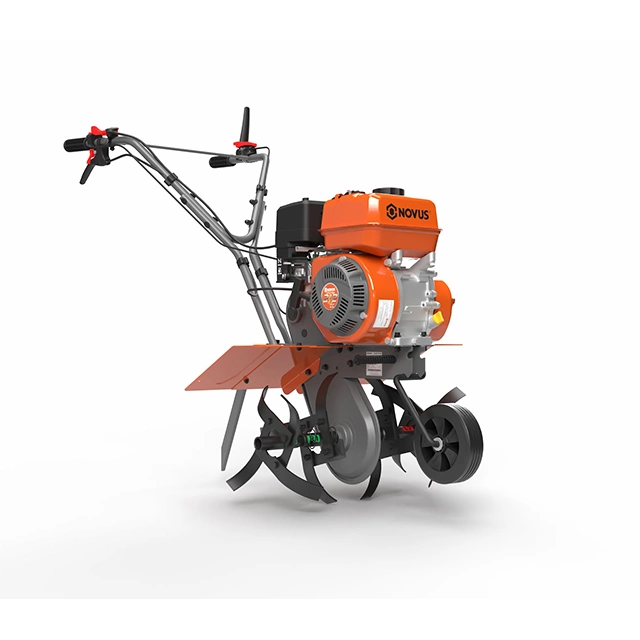
What is a Rear Tine Tiller?
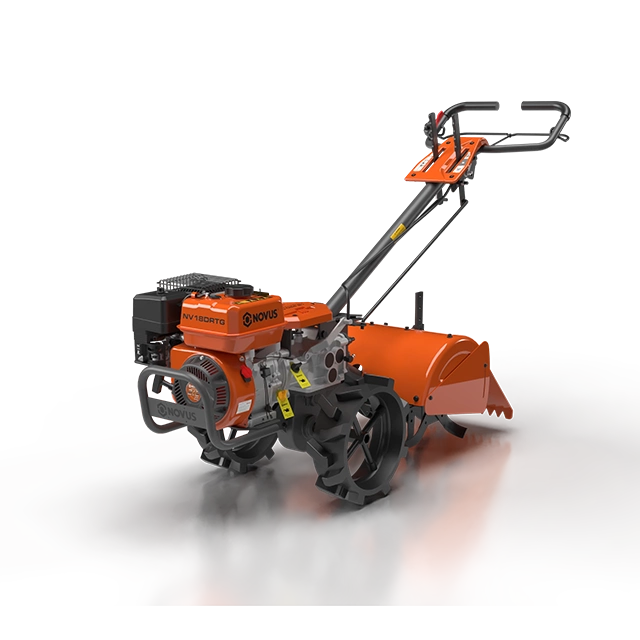
Working principle: The power of the engine is directly transmitted to the shaft of the cultivator knife at the rear, and the blade itself becomes a powerful “driving wheel”. They fiercely “bite” the soil, generating a huge forward traction force through rotation, thus pulling the machine and the operator forward.
Advantages
- Strong power performance
- The operation is more worry-free
- Soil crushing is more effective
Disadvantage
- More expensive
- The fuselage is heavy and not easy to move
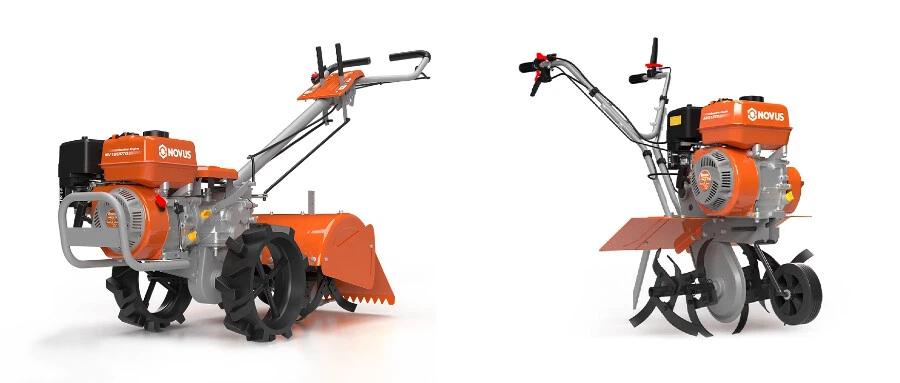
Comparison of Front Tine vs Rear Tine Tiller
| Contrast dimensionTillage stability | Novus Front Tine Tiller | Novus Rear Tine Tiller |
| In-depth cultivation ability | Tire-driven: The wheels provide forward power, and the tiller rotates passively. The operator needs to apply thrust. | Knife shaft drive: The tilling knife is the main driving wheel, generating a strong traction force and self-driving to pull the machine forward. |
| Applicable scenarios | Width: 21 inches (approximately 53cm)Depth: Shallow to medium (6-8 inches) | Width: 18 inches (approximately 46cm)Depth: Adjustable, deep cultivation |
| Operational difficulty | Smaller gardens and narrow Spaces allow for cultivation close to the roots of crops | In open fields and large fields, it has a strong tolerance for obstacles (grass, tree roots) |
| Weight | No need to push, just guide. It is not convenient to transport, but it is more labor-saving when farming because of its self-propelled function. | It requires thrust and is easy to handle and store. It is more difficult to cultivate. |
| Unique functions and designs | Heavier | Lightweight |
| Contrast dimensionTillage stability | Hexagonal knife shaft: Effectively prevents entanglement of weeds.Adjustable baffle: Controls the degree of soil lifting.Transport wheel: Easy to move. | Gear transmission gearbox: More durable, more efficient power transmission.Adjustable tillage depth: Precisely adapting to the needs of different crops.Reverse rotation blade option: Achieve an even more extreme soil crushing effect. |
How to Choose The Right Plow For You
When deciding whether to choose rear tine tiller or front tine tiller, the following aspects can be considered:
1. Soil type
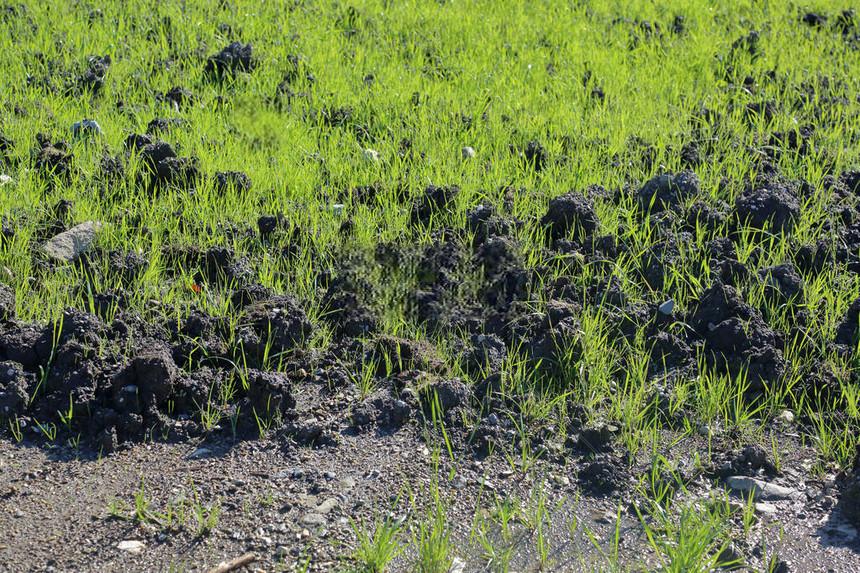
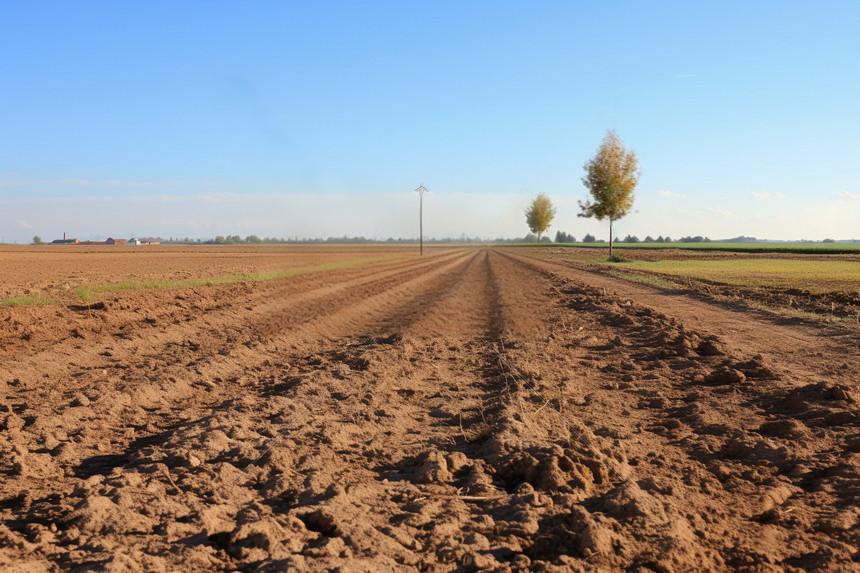
If your land is hard, clayey or uncultivated, it is recommended to choose a rear-mounted knife plow.If the soil is already soft or has been ploughed, a front-mounted knife plow is sufficient for use.
2. Garden area
- For a small garden plot of less than 1 mu: A front-tooth tiller might be sufficient.
- For areas of ≥ 1 mu or those requiring high-intensity and deep tillage: The back-toothed tiller is the only efficient and labor-saving choice.
3. Usage frequency
- If the soil is only turned over once or twice a year, the front-mounted knife model is more economical.
- If you need to plow the land frequently and prepare multiple vegetable gardens, a rear-mounted knife will save you more time and energy.
4. Operator experience
- The front-mounted tool machine is relatively lightweight but requires manual control of the direction.
- The rear-mounted knife machine is heavier but provides stable propulsion, making it suitable for users who pursue high efficiency and professional results.
5. Budget considerations
- The price of a front-mounted cutter is approximately 300 to 600 US dollars.
- The rear-mounted knife machine costs around 700 to 1,500 US dollars, depending on the power and functions.
Tips for Using A Plotter
Avoid farming on wet soil because it clumps together easily and gets compacted, hence offering poor air permeability.
It is better to shallow plough in several sessions than deep plough in one session.
Routine maintenance includes cleaning the blades, checking the engine oil, and transmission components.
Wear appropriate personal protective gear like gloves, protective eyewear, and safety shoes.
Summary
Once every year, if your core job is shallow plowing and mixing the field in your garden, then a front-tooth tiller is an economical choice. However, if you are not sure, land conditions are complex, and you want to solve the problem once for all, then the choice of a back-toothed tiller will be usually safer and more in tune with future needs. With strong function and labor-saving characteristics, it will make you love farming.


Leave feedback about this