

When using the Front Tine Tiller, the accuracy of the tillage depth setting will directly affect the efficiency of soil turning, the handling feel, and the final soil quality. Many beginners often encounter problems such as the machine constantly “jumping”, not being able to dig in, or getting stuck too deeply and being difficult to control.
Next, we will guide you step by step on how to correctly set the tillage depth of the front cultivator and share practical tips.
How Do Front Tine Tillers Control The Depth?
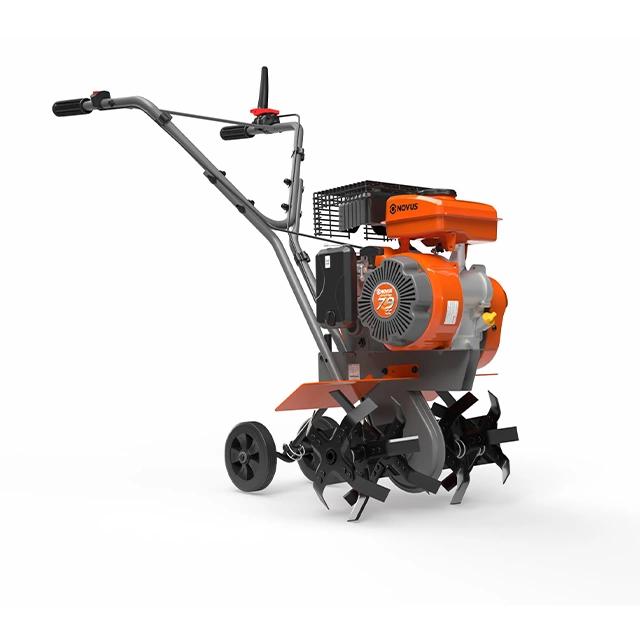
Unlike the rear plow, the depth adjustment of the front tine tiller is very intuitive and mainly relies on two key components:
Resistance rod / Depth lever
This is the most crucial component, usually located behind the rotary plow. It acts like a “brake”, directly limiting the maximum depth to which the plow blade can penetrate into the soil.
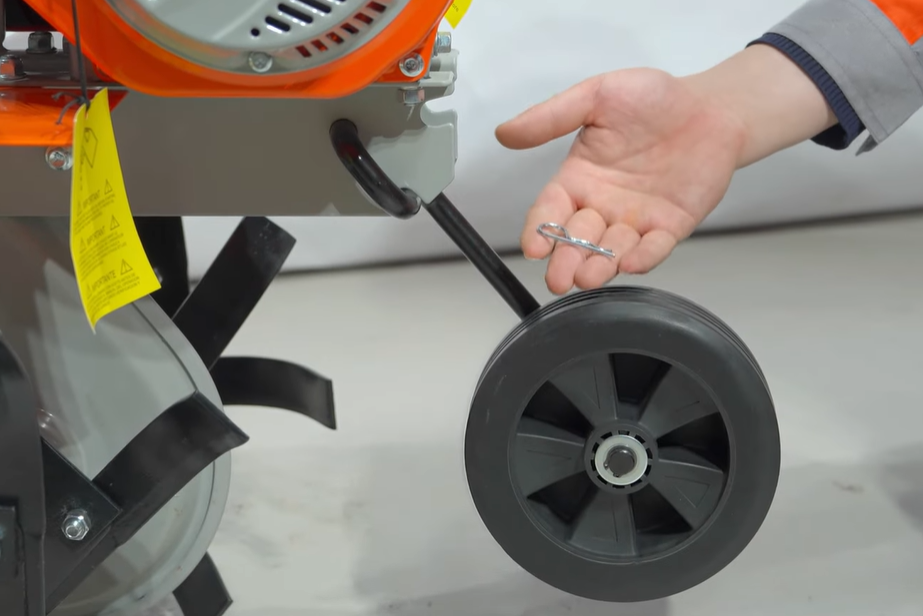
Depth-limiting wheels / Sliding feetMany models are equipped with depth-limiting wheels or bottom sliding feet. When they touch the ground, they can keep the plow blade at a stable height, ensuring uniform tillage depth and a smoother field surface.
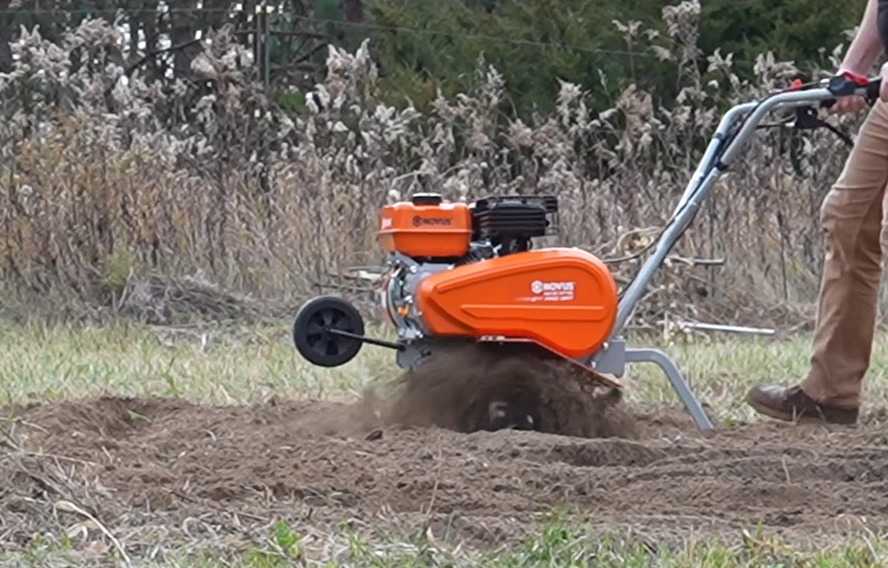
How to Set the Depth on a Front Tine Tiller
1. Resistance Rod Adjustment
This is the most direct method for controlling the depth. The adjustment methods vary slightly among different models, but the principle is the same:
To cultivate deeper: Lower the resistance rod.
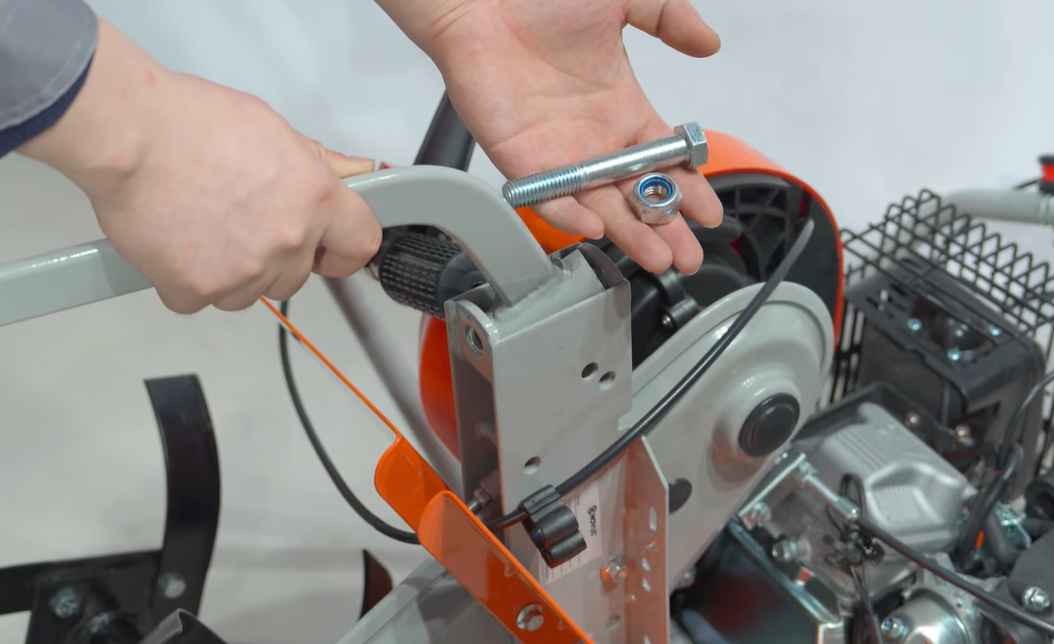
For models with holes: Insert the fixing pin into the higher hole of the resistance rod, or loosen the bolt to move the rod body downward.
In this way, the knife shaft can more easily penetrate the soil, and the cultivation depth naturally increases.
To achieve a shallower ploughing: Raise the resistance rod.
Insert the pin into a lower hole on the resistance rod, or move the rod body upwards.
The resistance rod will come into contact with the unturned hard soil layer earlier, restricting the downward movement of the knife shaft and thus controlling the depth.
2. Depth Adjustment of the Limiting Wheels (if equipped)
If your machine is equipped with limiting wheels, they are a great helper in ensuring the quality of farming operations:
Lowering the limiting wheels → The blade shaft is closer to the ground, the plowing depth becomes shallower, suitable for fine soil breaking, weeding, and other shallow operations.
Raising the limiting wheels → The blade shaft can extend further, the plowing depth increases, suitable for plowing and deep plowing.
3. Pilot operation and fine-tuning
After conducting a small-scale trial operation for a few meters, observe the results:
- If the machine vibrates significantly → The depth might be too shallow
- If the machine has difficulty moving forward → The depth might be too deep
- If the soil is evenly turned over and the machine moves steadily → The depth is appropriate
Adjust the height of the depth-limiting lever according to the situation for fine-tuning.
Depth References for Different Scenarios
Having mastered the adjustment methods, you also need to set the depth according to the task objectives. Here are some reference values for common scenarios:
| Scene | Recommended plowing depth | Adjustment suggestions |
| Preparation of the soil before sowing | 2 – 4 inches | Adjust the resistance rods to a medium-high position, raise the depth-limiting wheels slightly, and ensure that the topsoil is crushed finely. |
| Deep ploughing / Soil turning | 4 – 6 inches | Adjust the resistance rods to a lower position, while reducing the forward speed to prevent the machine from overloading. |
| Weeding / Shallow ploughing | 1 – 2 inches | Adjust the resistance rods to the highest position and lower the depth-limiting wheels, and only turn over the top layer of soil. |
Operating Safety Reminder
- When adjusting, make sure to turn off the engine and stop the machine, and remove the spark plug to prevent the tiller from rotating accidentally and causing injury.
- When making a turn at the field edge or transferring to a new plot, lift the tiller and let the shaft completely leave the ground.
- For the first use or when operating on unfamiliar plots, start with shallow tillage, gradually deepen it, observe the machine’s load, and then make adjustments.
Frequently Asked Questions (FAQ)
How deep can a front plow-type tiller typically till the soil?
It usually ranges from 10 to 15 cm, depending on the soil conditions and the model.
Why is the tiller constantly jumping?
In most cases, it is because the plowing depth is too shallow, or the soil is too hard, and it needs to be gradually deepened.
Can the machine be made to plow deeper by adding weight?
It is not recommended. Increasing the weight might affect balance and safety.


Leave feedback about this