

When purchasing a generator, many people often encounter a question: What are the differences between an inverter generator and a regular generator?
Although both can provide power during power outages, outdoor work, or camping, they have significant differences in terms of working principle, power output quality, fuel efficiency, noise control, and applicable scenarios. For household users, campers, and outdoor campers, inverter generators are becoming increasingly popular; while in construction sites, farms, and for powering large equipment, regular generators still play an important role.
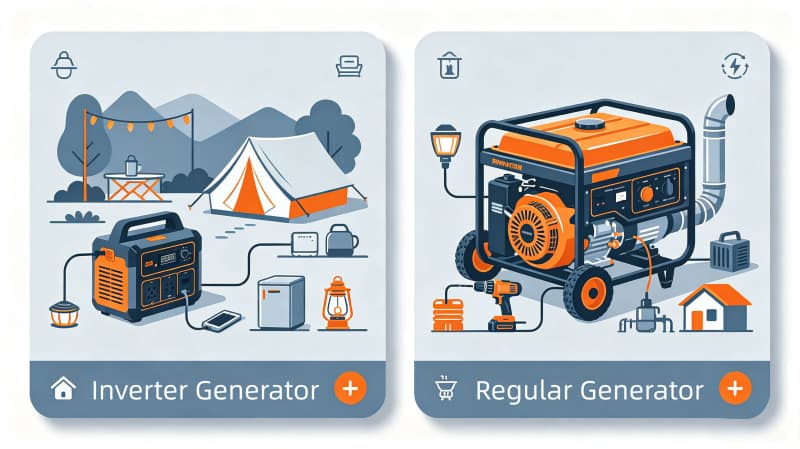
What Is an Inverter Generator?
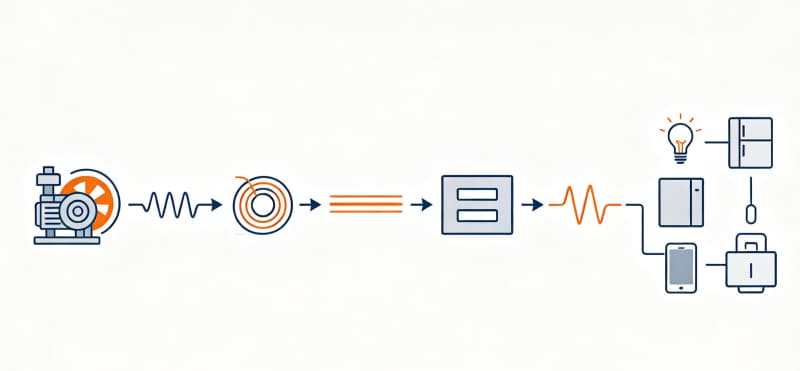
An inverter generator is a modern power generation device that uses digital inverter technology. It employs a multi-stage “AC-DC-AC” power conversion technology. It first generates high-frequency AC power, then converts it to clean DC power via a microprocessor-controlled digital inverter, and finally inverts it back into stable AC power. This allows the generator speed to automatically adjust according to the actual load, operating at low speeds when the load is low, thus achieving energy saving and quiet operation.
What Is a Regular Generator?
Conventional generators typically employ a fixed-speed operation mechanism, with the engine maintaining a constant speed of 3000 rpm to directly generate 50Hz AC power. This method is simple in structure, but the engine must run at full speed regardless of the load, resulting in high noise and fuel consumption.
What’s the Difference Between Inverter Generator And Generator
Power output quality
Power quality is one of the biggest differences between the two types of generators.
The inverter generator outputs a pure sine wave power supply, with very little voltage fluctuation, and can stably supply power to precision electronic products such as laptops, smartphones, televisions, drones, battery chargers, and medical equipment. In contrast, the output voltage of a regular generator fluctuates with the engine speed. Although it can meet the usage requirements of most ordinary electrical appliances and power tools, for high-precision electronic devices, long-term use may pose certain risks.
Equipment suitable for inverters:
- Laptop computers
- Mobile phones and tablets
- UAV chargers
- Medical equipment
- Televisions and audio equipment
Equipment suitable for regular generators:
- Electric drill
- Electric saw
- Pump
- Air compressor
- Industrial equipment
Fuel efficiency
One of the greatest advantages of an inverter generator is that it is more fuel-efficient.
Due to the adoption of an intelligent control system, it can automatically adjust the engine speed according to the actual load. When only a few lighting lamps or mobile phones are being charged, the engine will automatically reduce its speed to minimize fuel consumption.
Ordinary generators, on the other hand, need to maintain a constant rotational speed throughout their operation. Even when the load is only 20%, the engine still operates at a relatively high speed, resulting in significantly higher fuel consumption.
For users who have been using generators for a long time, although the cost of purchasing an inverter generator is higher, the long-term savings in fuel expenses can effectively reduce the overall usage cost.
Noise Level
If the usage environment has strict requirements for noise, the inverter generator has significant advantages.
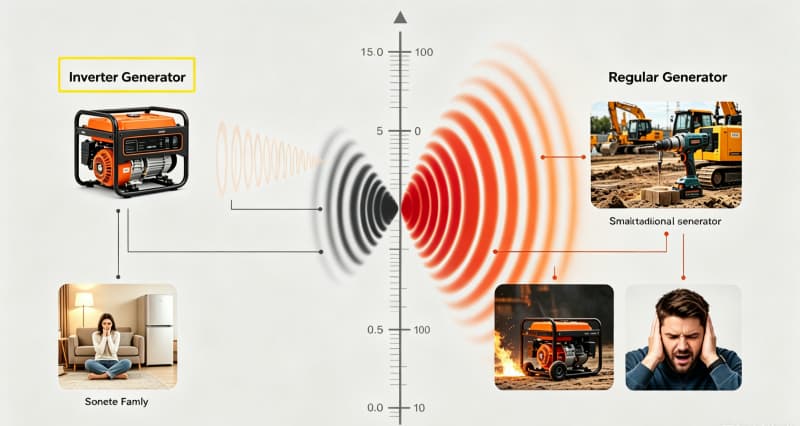
Generally speaking:
- Inverter generator: approximately 50 – 65 dB
- Conventional generator: approximately 70 – 85 dB
50 decibels is roughly the volume of normal conversation, while 80 decibels is already close to the noise level of a busy road or a vacuum cleaner in operation.
Therefore, in camping, RV travel, nighttime use, and residential areas and other environments, inverters can provide a more comfortable usage experience.
Portability
Inverter generators typically adopt a closed box design, which is lighter in weight and is equipped with handles or wheels for easy transportation.
Currently, the inverters with power of around 2kW on the market usually weigh only about 20 kilograms, and can be easily moved by one person.
In contrast, ordinary generators of the same power usually adopt an open steel frame structure, which is heavier and more suitable for long-term use at fixed locations.
If you need to frequently move your equipment, such as during camping, self-driving trips or mobile construction, an inverter generator is obviously more convenient.
Power Output Capability
Many people think that the power of an inverter generator is relatively low, but this is not entirely accurate.
At present, the inverter generators available in the market mainly range from 1000W to 4500W, and they can already meet the power supply needs of household backup power sources, campers, outdoor activities, and most daily electrical appliances.
Ordinary generators, on the other hand, have a greater power advantage. Common models include:
- 5000W
- 8000W
- 10000W
- More than 12000W
Therefore, when it is necessary to power large air compressors, electric welding machines, large water pumps or multiple devices simultaneously, ordinary generators usually have a greater advantage.
With the advancement of technology, more and more high-power inverter generators and parallel functions have entered the market, providing users with a new option that combines stable power supply with high output power.
Price and Long Term Cost
From the perspective of purchase cost, ordinary generators are generally more economical.
The inverter generator, due to the addition of a digital inverter control system, usually has a higher initial price.
However, when considering the overall cost of long-term use, the inverter generator often offers better overall value due to its lower fuel consumption, less noise, and higher power quality.
For household users who frequently use generators or outdoor enthusiasts, the long-term savings in fuel costs are sufficient to cover part of the purchase cost.
Which Generator Should I Choose for Different Use Cases?
Different users have different needs, and therefore different products are suitable for them.
| Usage scenario | Recommended Products |
| Backup power supply for the household | Choose based on the total power demand of the household. For daily use, consider the inverter generator as the priority option. |
| RV travel | Inverter Generator |
| Outdoor camping | Inverter Generator |
| Nighttime use | Inverter Generator |
| Mobile phones, computers and other electronic devices | Inverter Generator |
| Construction sites | Regular Generator |
| Farm irrigation | Regular Generator |
| Electric welders, electric tools | Regular Generator |
| Long periods of high-load operation | Recommended Products |
If you need a quiet, fuel-efficient, and safe power supply for electronic devices, an inverter generator is usually a better choice; if you prioritize high power output and budget control, a regular generator still offers good value for money.
Summary
Inverter generators and ordinary generators each have their own advantages, and there is no such thing as being “absolutely better”. The key lies in whether they meet the actual usage requirements.
If you are more concerned about power stability, low noise, fuel economy and portability, then an inverter generator is undoubtedly the ideal choice for home backup, RV travel, outdoor camping and powering electronic devices. For scenarios such as construction sites, agricultural production, large machinery operations and continuous high-load operation, ordinary generators still have an irreplaceable advantage due to their greater output power and lower purchase cost.
When making a purchase, it is recommended to consider the actual usage scenarios, power requirements of the equipment, and long-term operating costs comprehensively, so as to select a generator that truly suits your needs.


Leave feedback about this