

Using a pump to drain a pool is much faster than using a small submersible pump or other slow drainage methods. However, there is no fixed duration for the drainage process. For a small above-ground swimming pool, it can be emptied within less than an hour; for a household large swimming pool, it often takes several hours.
The actual drainage time depends on the volume of the pool, the flow rate of the pump, and the working conditions on site. A rough estimate can be made through simple calculations, but factors such as the length of the pipes, the height difference, and debris will cause the actual drainage time to increase.
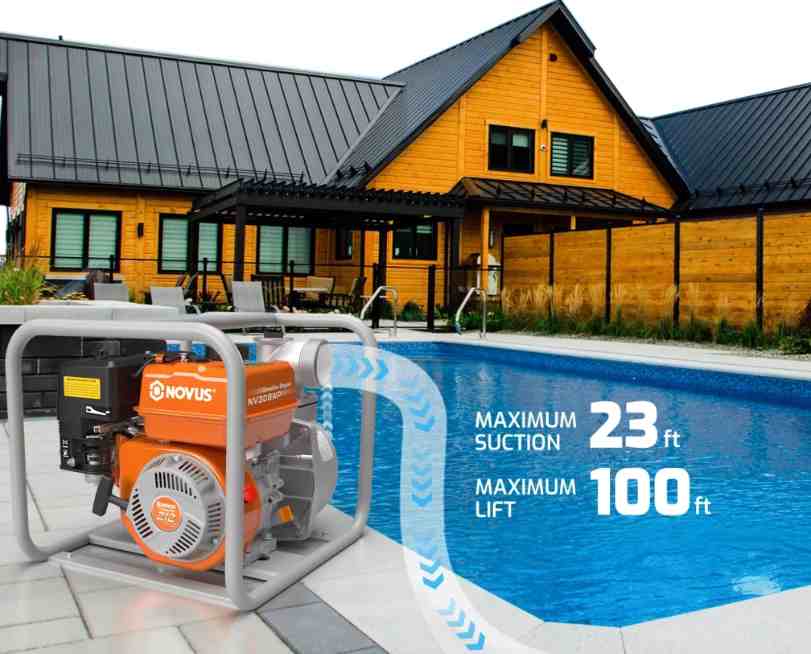
Pool Draining Time by Pool Size
One of the easiest ways to estimate pool draining time is to compare the pool’s water volume with the pump’s flow rate.
For example, if a pool contains 10,000 gallons of water and a pump moves 100 gallons per minute (GPM), the theoretical draining time would be:
10,000 gallons ÷ 100 GPM = 100 minutes
The table below provides some simple examples based on different pool volumes and flow rates.
| Pool Water Volume | 100 GPM | 150 GPM | 200 GPM |
| 5,000 gallons | 50 min | 33 min | 25 min |
| 10,000 gallons | 1 hr 40 min | 1 hr 7 min | 50 min |
| 20,000 gallons | 3 hr 20 min | 2 hr 13 min | 1 hr 40 min |
| 30,000 gallons | 5 hr | 3 hr 20 min | 2 hr 30 min |
These figures are theoretical estimates rather than guaranteed draining times. A pump’s advertised maximum flow rate is usually measured under specific conditions. Actual flow can be lower once hoses, elevation changes, and other resistance are introduced.
How to Estimate Your Own Pool Draining Time
If you want a more useful estimate for your particular pool, you only need a few basic pieces of information.
Determine Your Pool’s Water Volume
First, estimate how much water the pool contains. For a rectangular pool, a basic calculation is:
Length × Width × Average Depth = Water Volume
If the measurements are in feet, multiply the result by approximately 7.5 to convert cubic feet into US gallons.
For example, a pool that is 30 feet long, 15 feet wide, and has an average depth of 4 feet contains approximately:
30 × 15 × 4 × 7.5 = 13,500 gallons
For round or irregularly shaped pools, the calculation is slightly different, but the same principle applies: determine the approximate number of gallons that need to be removed.
Check the Pump’s Flow Rate
Next, check the water pump’s rated flow rate, usually expressed in gallons per minute (GPM).
A higher GPM generally means a shorter theoretical draining time. However, it is important to distinguish between a pump’s maximum rated flow and the flow it can deliver under your actual setup.
If a pump is rated at 150 GPM, for example, you should not automatically assume that it will maintain 150 GPM throughout the entire draining process.
Use the Simple Formula
Once you know the pool volume and the pump’s expected flow rate, the basic calculation is:
Pool Volume ÷ Pump Flow Rate = Estimated Draining Time
For example:
13,500 gallons ÷ 150 GPM = 90 minutes
This gives you a starting estimate of about 1.5 hours. In practice, it is sensible to allow additional time because operating conditions rarely match the ideal conditions used for a simple calculation.
Related Articles:
Best Way to Pump Water Out of a Swimming Pool When Debris Is Present
How to Drain a Pond with a Pump: Common Mistakes to Avoid
Why Does It Take Longer Than the Estimated Time?
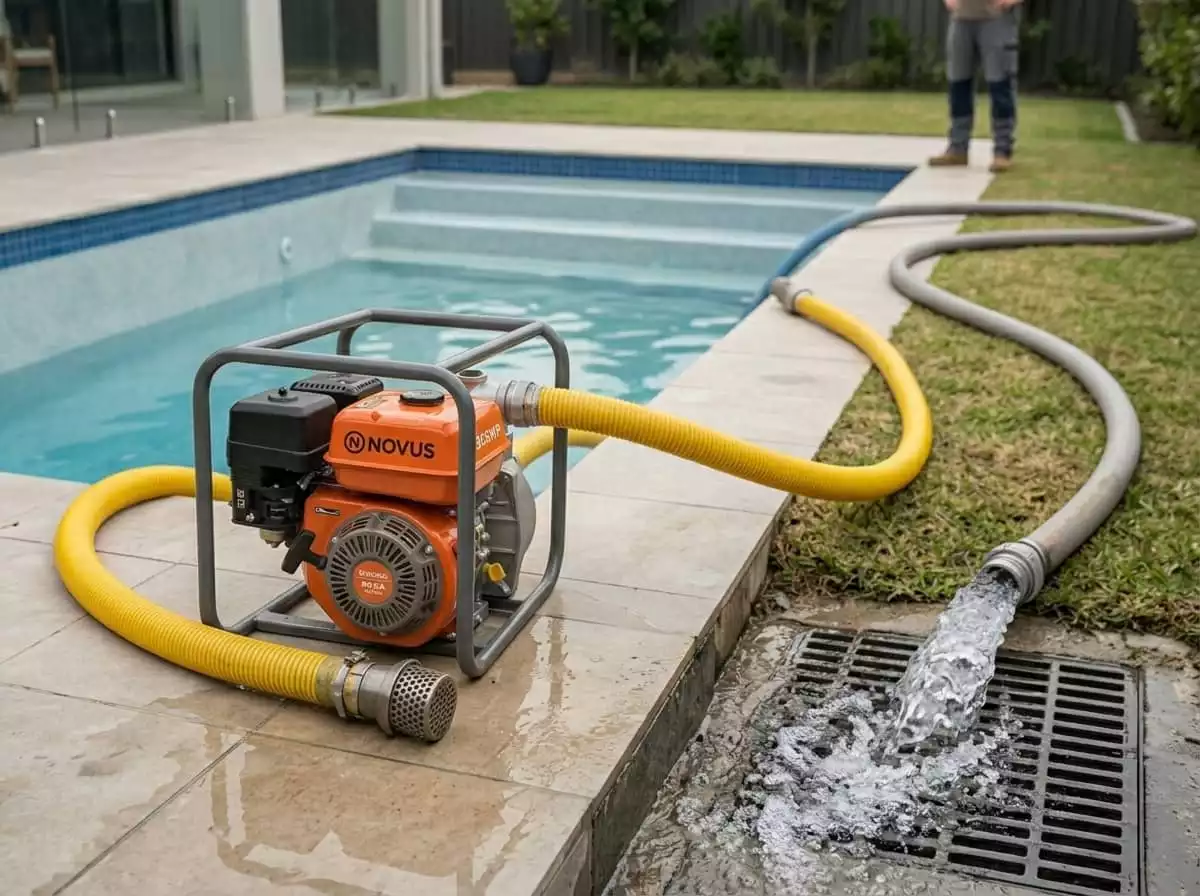
The formula above assumes that the pump maintains a constant flow rate. Real-world pumping conditions are more complicated, and several factors can reduce the actual flow.
Maximum Flow Rate vs. Actual Flow Rate
A pump’s maximum GPM is not necessarily the flow rate you will get during pool draining. Flow decreases as the resistance in the discharge system increases.
The pump’s performance can also change depending on the total head it needs to overcome. For this reason, looking at the pump’s performance information rather than relying on a single maximum GPM figure can provide a more realistic estimate.
Hose Length and Diameter
The discharge hose can have a significant effect on flow.
A long hose creates more resistance than a short hose, while a hose with a smaller internal diameter can restrict the amount of water the pump can move. Sharp bends, kinks, and unnecessary connections can also reduce flow.
For this reason, the hose should generally be appropriately sized for the pump and arranged with as few unnecessary restrictions as possible.
Vertical Lift and Discharge Height
The direction of water flow should also not be ignored.
If the pump is to lift the water to a higher position for discharge, it needs to overcome the vertical head. The greater the head, the lower the water discharge flow rate, and the time required to empty the swimming pool will also increase.
Generally speaking, when the pump is close to the swimming pool and the drainage elevation increase is not large, its working efficiency will be much better than the situation where the pipeline is long and the drainage drop is large.
Water Level Changes During Draining
The pumping conditions can also change as the pool empties.
At the beginning, there is plenty of water available around the pump’s intake. As the water level drops, maintaining effective water flow can become more difficult, particularly near the end of the process.
Depending on the pump and setup, some water may remain in low areas of the pool and require additional handling.
Debris and Flow Restrictions
Leaves, sand and other debris are prone to clog the water intake or the filter. Even pumps that can handle a small amount of solid impurities will have a reduced water output if the water inlet is partially blocked.
To ensure the water inlet is unobstructed and to match the appropriate filter, the pump can operate continuously and stably.
What Type of Water Pump Is Best for Draining a Pool?
The best pump depends on the condition of the water, the size of the pool, and how quickly the water needs to be removed.
Clean Water Pumps
A clean-water pump can be suitable when the pool water is relatively clear and contains little or no solid debris. These pumps are designed primarily for moving clean or lightly contaminated water.
If the pool has been well maintained and there is minimal debris, a clean-water pump may be sufficient for the job.
Semi-Trash Pumps

A semi-trash pump can be useful when the water contains small amounts of leaves, sediment, or other small debris.
The term “semi-trash” does not mean that the pump can handle unlimited debris. Pumps in this category have a defined solids-handling capability, so the manufacturer’s specifications should always be checked before use.
For example, Novus offers gasoline-powered 2-inch and 3-inch semi-trash water pumps designed for moving large volumes of water while handling a certain amount of small debris. These types of pumps can be considered when pool water is not completely clean or when a higher flow rate is needed.
Choosing Pump Flow Rate for Your Pool
For pool draining, flow rate is one of the most important specifications to consider. A higher rated flow can reduce theoretical pumping time, but it should not be considered on its own.
The pump’s maximum flow, total head, hose configuration, discharge distance, and water conditions all influence actual performance.
Rather than choosing the largest pump available, it is better to consider the complete pumping setup and select a pump that provides sufficient flow for the pool volume and operating conditions.
The duration of pool drainage is mainly determined by the pool volume and the actual flow rate of the pump. By dividing the total gallons of the pool by the pump’s flow rate per minute, you can calculate the theoretical drainage time. However, the actual time usually takes longer than that.
The thickness of the water pipe, the length of the pipe, the vertical lift, the change in water level, and the presence of debris in the water all affect the efficiency of the pump. Taking these factors into account before draining the pool will help you make a more accurate estimate and select the appropriate pump.


Leave feedback about this